Your SIRS Report Just Arrived. Here’s Everything Your Board Needs to Decide, Defend, and Fund

Author: Greg Batista, PE, CGC, SI, President of G. Batista Engineering & Construction
Last Updated: October 2026
A completed Structural Integrity Reserve Study (SIRS) is a legal document that tells your board exactly how much money it must set aside, on what schedule, to keep eight structural and life-safety components of your building funded for repair or replacement. Once it’s in hand, Florida law gives your board specific things it must do with it, not someday, but starting with this year’s budget.
Boards that treat the SIRS as a filing-cabinet item rather than a funding mandate are the ones who end up explaining a six-figure special assessment to angry owners eighteen months later. This article walks your board through what the report actually says, what you’re legally required to do with it, and where the five most common flashpoints (mismatched numbers, coverage gaps, delay costs, procedural steps, and personal liability) come from, each of which we will cover in its own companion article.
Download the SIRS Board Guide (PDF)
What Does a Completed SIRS Actually Tell Your Board?
A completed SIRS Report provides condominium board members with a detailed breakdown of building components, estimated replacement costs, remaining useful life, and recommended reserve contributions.
What Exactly Did Your Board Just Receive?
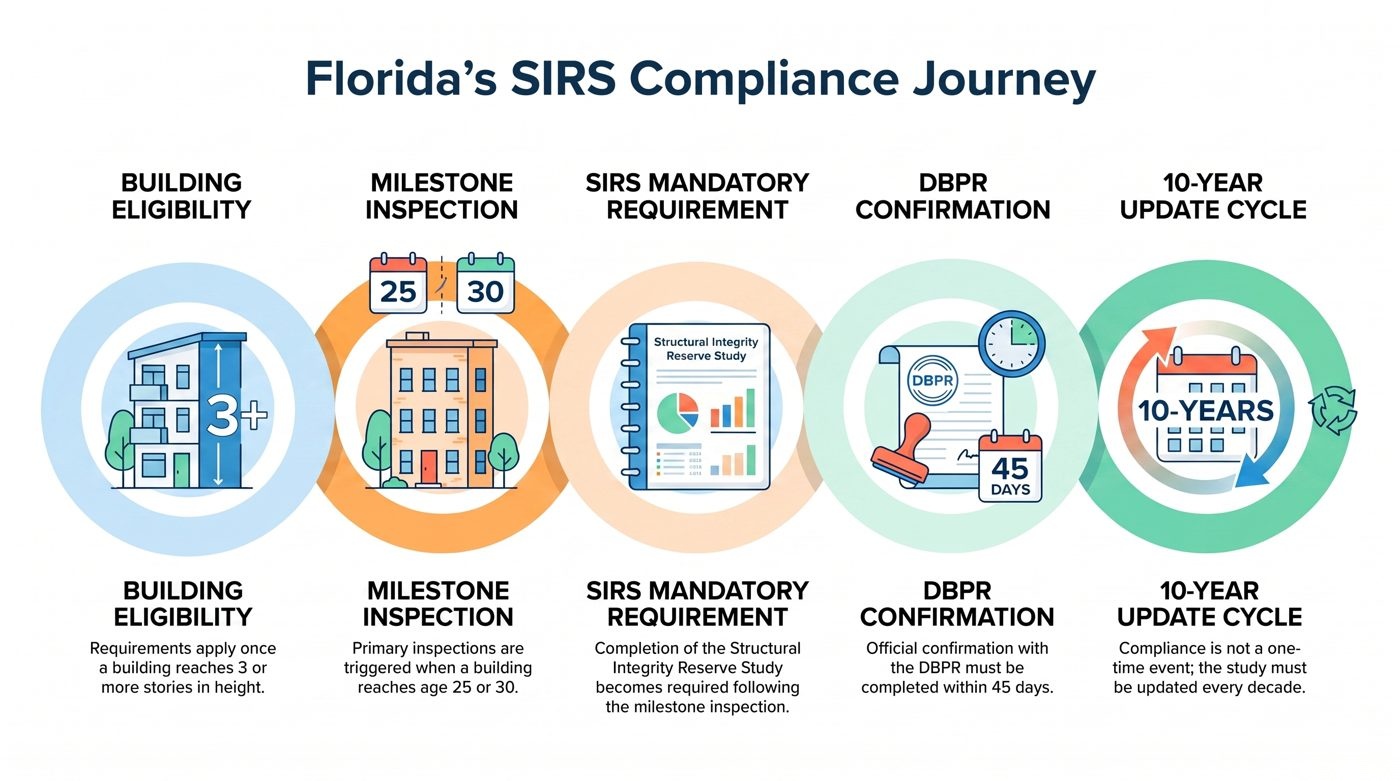
Your board just received an engineering document that legally converts “we should probably save some money” into a specific, component-by-component funding requirement. A Structural Integrity Reserve Study is not a maintenance checklist and it is not a repair estimate: it’s a reserve-funding roadmap built from a visual inspection of your building’s structural and life-safety systems, required under Florida Statute 718.112(2)(g) for condominiums and 719.106 for cooperatives, for any building three or more habitable stories in height.
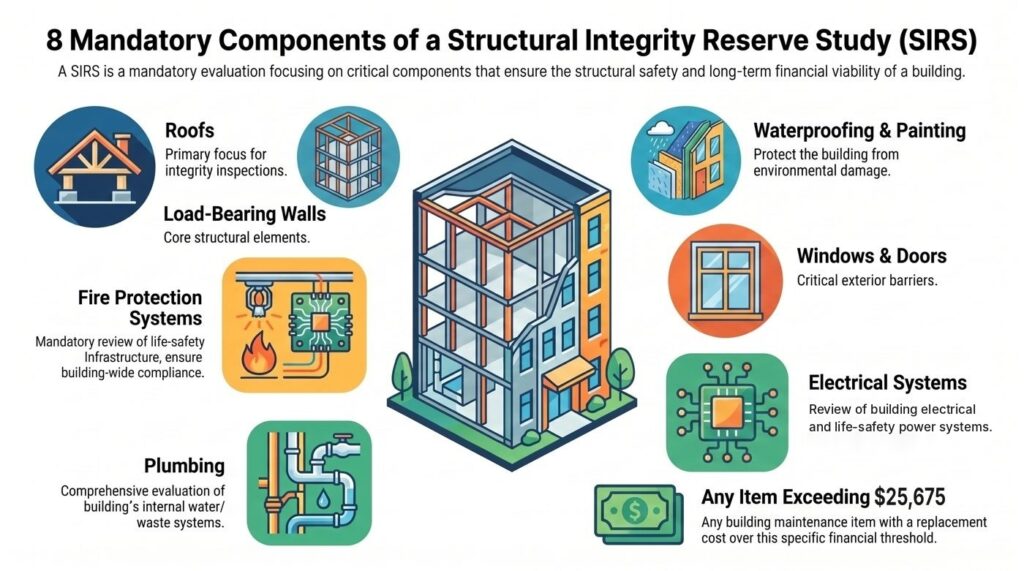
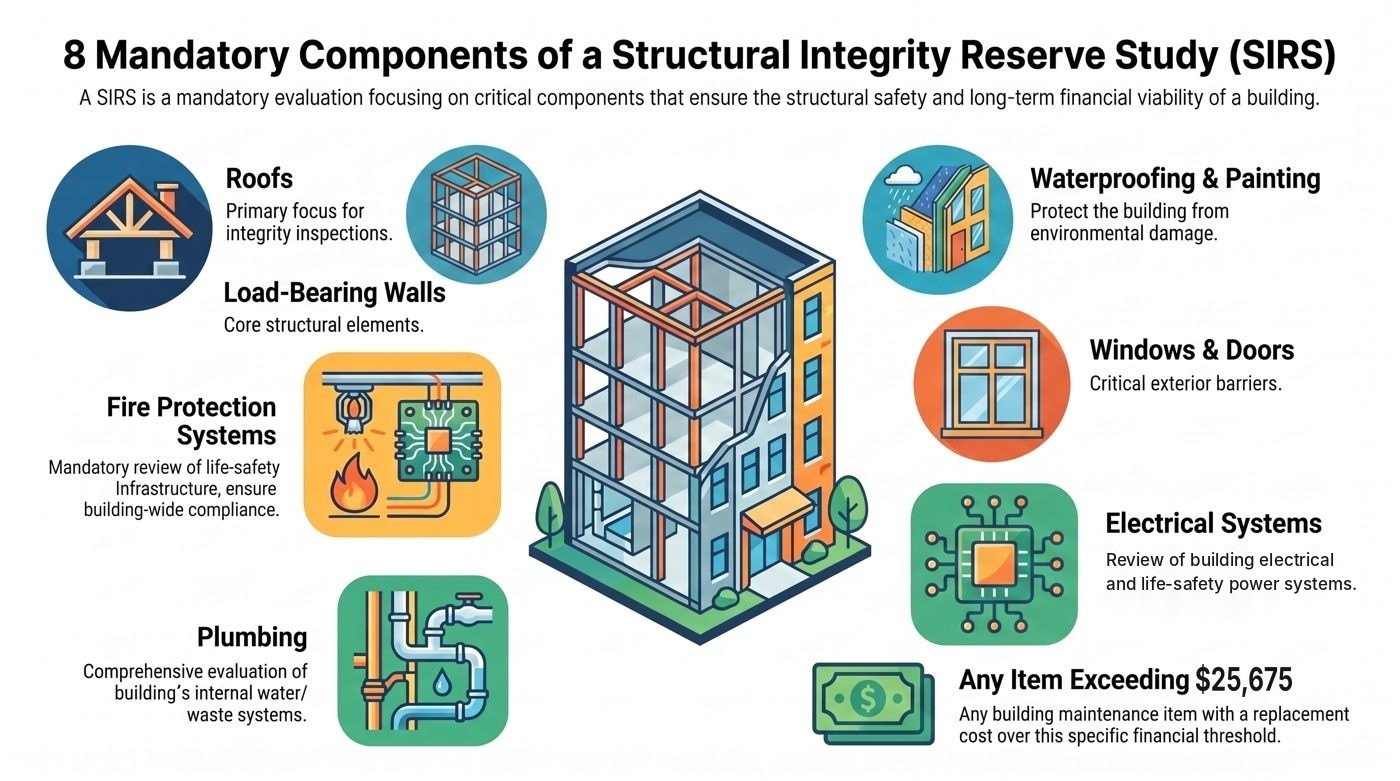
A compliant SIRS covers eight required categories: roof; load-bearing walls and other primary structural members; fireproofing and fire protection systems; plumbing; electrical systems; waterproofing and exterior painting; windows and exterior doors; and any other item with a deferred maintenance expense or replacement cost exceeding $25,675 (the current inflation-adjusted threshold) that, if left unaddressed, would negatively affect any of the components above. For each of those categories, the report has to state the component’s estimated remaining useful life, its estimated replacement or deferred-maintenance cost, and the annual reserve contribution needed to fully fund it by the end of that useful life. That’s the document your board is holding.
What Does the Report Actually Determine for Your Building?
The report determines three things your board can no longer treat as optional: how much money has to move into reserves, on what timeline, and who signs off on having read it. Since HB 913 took effect, officers and directors are required to sign an affidavit acknowledging receipt of the completed SIRS, a paper trail that puts the report’s findings on the record as something the board knew, not something it can later claim it missed.
By reviewing the SIRS Report carefully, board members can identify which building components require greater financial attention and develop a more informed reserve funding strategy.
-
Funding level: for budgets adopted on or after December 31, 2024, unit owners can no longer vote to waive or reduce reserves for the eight SIRS structural components: the days of a member vote zeroing out the roof reserve line are over for these categories.
-
Funding mechanism: the board can fund the SIRS-mandated reserves through regular assessments, a special assessment, a line of credit, or a loan, and can pool reserve accounts without a unit-owner vote.
-
Documentation: within 45 days of completion, a SIRS confirmation must be submitted to the Department of Business and Professional Regulation (DBPR), and the signed officer/director affidavit becomes part of the association’s official records.
Why Does Getting Your SIRS Right Matter for Your Board?
Getting the SIRS right matters because the numbers in that SIRS report are no longer advisory: they are the funding floor your budget has to meet, and the gap between what your reserves currently hold and what the SIRS says they need is a liability the board now knows about in writing.
As a licensed Professional Engineer (PE), Certified General Contractor (CGC), and Special Inspector (SI), I’ve sat across the table from boards the week their SIRS lands, and the credential that matters most in that room isn’t the license on my wall: it’s being able to tell a board, component by component, which numbers in that report reflect genuine structural risk and which reflect a conservative engineering assumption that has some room to be discussed with the preparer before it’s locked into next year’s budget.
A properly reviewed SIRS Report can help condominium associations understand potential funding shortfalls and plan for future repair or replacement expenses.
-
Financial exposure: an underfunded SIRS line item doesn’t disappear: it resurfaces later as a special assessment, usually at a higher cost than if it had been funded on schedule.
-
Legal exposure: the officer/director affidavit means the board can’t later claim it wasn’t told; ignoring a documented shortfall is a different legal posture than never having known about it.
-
Resale and insurance exposure: buyers, lenders, and insurers increasingly ask for SIRS status and funding level before closing or renewing a policy, particularly for buildings in coastal counties.
What Does This Look Like in a Real South Florida Building?
The lesson from this one: a board that reads its SIRS report line by line in the first thirty days, instead of tabling it for the next meeting, ends up with options: a board that doesn’t ends up with an emergency vote.
The Report Nobody Read
I was called into a residential condominium in Fort Lauderdale about six weeks after their SIRS report had been completed by another firm. The report had been emailed to the property manager, forwarded to the board distribution list, and, as far as I could tell, opened by exactly one person. The Board President had skimmed the executive summary, seen a total reserve-funding figure that was roughly two and a half times what the association currently held in its accounts, and quietly decided the number had to be a mistake. Nobody had scheduled a meeting to go through the report component by component, and the 45-day DBPR confirmation deadline was eleven days away when my firm got the call.
Reading the Report Component by Component
We sat down with the Board President, the Treasurer, and the property manager on a Tuesday evening in the clubhouse, and I walked them through the SIRS report the way I walk every board through one, not from the executive summary backward, but from the eight required categories forward. The roof had eleven years of remaining useful life and a reserve target that was actually lower than what a lot of boards assume for a building of that age and coastal exposure.
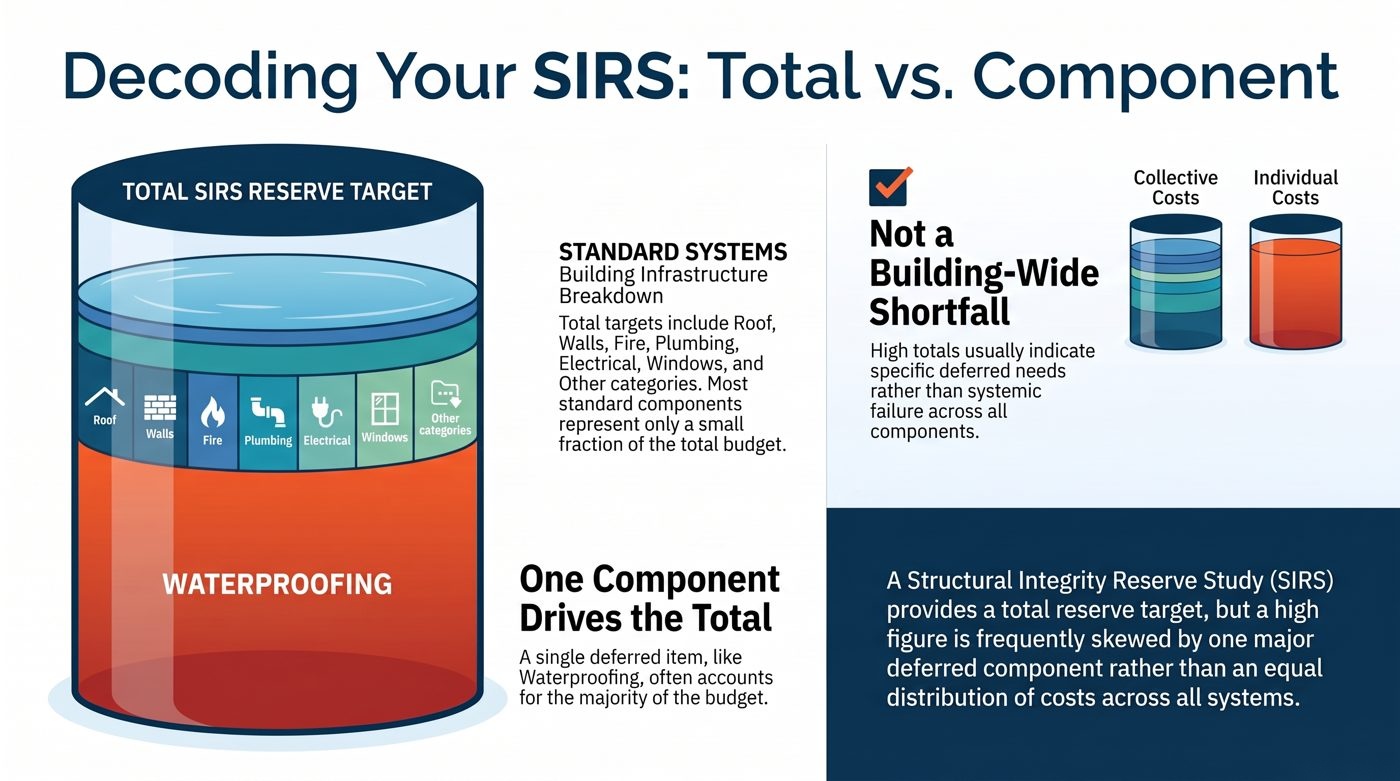
The waterproofing and exterior painting line, on the other hand, was carrying a $340,000 replacement figure with only four years of remaining useful life, because the building’s last exterior recoating had been deferred twice in the prior decade. That single line item, not the roof or the plumbing, was responsible for most of the gap between what the board expected and what the report said.
One Deferred Category, Not a Whole-Building Problem
Once the Treasurer understood that the number wasn’t an across-the-board correction but a concentrated shortfall in one deferred category, the conversation changed completely. Instead of an emergency special assessment covering the entire reserve gap, the board approved a three-year phased funding plan for the waterproofing line specifically, paired with a modest increase to the regular assessment, and had the signed affidavit and DBPR confirmation filed four days before the deadline.
The Board President told me afterward that the number on the executive-summary page had genuinely scared the board into thinking the whole building was in trouble, when in fact one deferred maintenance category was doing almost all of the work, a distinction that only becomes visible once someone walks the board through the SIRS report component by component instead of leading with the total.
Presenting the Plan to Owners
The real test of that plan came two months later, at the association’s annual meeting, when the Treasurer had to stand in front of roughly sixty owners and explain why the regular assessment was going up. I sat in the back of the clubhouse that night at the Board President’s request, in case any engineering questions came up. The Treasurer didn’t lead with the SIRS total either (she’d learned that lesson from the board meeting) and instead put up a single slide showing the eight components with the waterproofing line highlighted, the same way I’d walked the board through it.
She told the room plainly that seven of the eight systems in the building were adequately funded, that one, the exterior waterproofing, deferred twice in the prior decade, was carrying a $340,000 replacement cost with only four years of remaining life, and that the board had chosen a three-year phased increase over a lump-sum special assessment specifically to keep the number predictable for owners on fixed incomes.
The Question Every Board Hears
A retired owner in the third row asked the question I hear at nearly every one of these meetings: why hadn’t this come up sooner, back when the recoating could have been handled as routine maintenance instead of a reserve emergency. The Treasurer didn’t have a satisfying answer for that one, and to her credit she didn’t invent one: she said the prior board had deferred the recoating twice without documenting why, and that the current board’s job now was to make sure the SIRS made that kind of silent deferral impossible going forward.
That answer, more than the funding plan itself, was what seemed to settle the room. By the end of the meeting the phased assessment passed without a formal vote being forced, and two owners stayed afterward to ask the Treasurer for a copy of the eight-component slide to keep for their own records. It’s a small detail, but it’s the one that tells me the board did this right: the owners left informed rather than alarmed, with a specific reason for the increase instead of a vague number attached to a scary-looking report.
Structural Integrity Reserve Study Quote in 24 Hours
What Do Condo Boards Usually Ask When Their SIRS Report Arrives?
Do We Have to Accept the Numbers in the SIRS As Final?
No, the numbers in a SIRS are the preparer’s professional engineering judgment, not an unchallengeable government mandate, and a board can ask the preparer to walk through the assumptions behind any specific line item. If a board has genuine questions about a remaining-useful-life estimate or a replacement-cost figure, the right move is a direct conversation with the licensed engineer, architect, or credentialed reserve specialist who prepared the study, not a unilateral board decision to disregard the number. Boards should document that conversation and any resulting revision in the official records, since the affidavit requirement means the board is on record as having received the original findings.
What Happens If We Miss the DBPR Confirmation Deadline?
Missing the confirmation deadline puts the association out of compliance with a statutory filing requirement, which can expose it to enforcement inquiries and complicates the board’s ability to show good-faith compliance if a dispute arises later. The confirmation itself is a relatively simple filing once the SIRS is complete, so the real risk is usually not the filing step but delaying the underlying study long enough that the deadline arrives with no report in hand. Boards that are close to a deadline should prioritize scheduling the inspection over debating funding strategy: the funding conversation can happen once the report exists.
Can We Still Waive or Reduce Reserves for These Components?
No, for budgets adopted on or after December 31, 2024, unit owners cannot vote to waive or reduce reserve funding for the eight structural components a SIRS covers, even with a member vote that would have been permitted for other reserve categories before this rule took effect. This is one of the more significant post-Surfside changes to Florida condominium law, and it’s a frequent point of confusion for boards used to the pre-2022 practice of voting to reduce or skip reserve contributions in a tight budget year. Non-SIRS reserve categories may still be subject to waiver votes depending on the association’s governing documents, so it’s worth confirming with counsel which reserve lines are and aren’t affected.
How Often Do We Have to Do This Again?
A SIRS must be updated at least every ten years for each qualifying building, though a board can commission an update sooner if conditions change materially (after a major storm event, for example), or once a deferred component finally gets replaced. Associations that recently completed a milestone inspection under Florida Statute 553.899 should talk to their engineer about how HB 913’s coordination provisions affect their specific SIRS timing, since the two inspection cycles are meant to work together rather than independently. Treat the ten-year cycle as a ceiling, not a target: waiting the full decade when a component’s condition has clearly changed is how boards end up back in this same situation with less runway.
What Do These SIRS Terms Actually Mean?
A Structural Integrity Reserve Study (SIRS) is a reserve funding analysis, grounded in a visual inspection, that determines how much an association must reserve annually to fully fund the repair or replacement of eight specific structural and life-safety components. It is distinct from a general reserve study in that Florida law dictates exactly which components must be covered and prohibits waiving or reducing funding for them once the study is complete.
Remaining useful life is the engineer’s estimate of how many more years a given component can reasonably be expected to perform its function before it requires major repair or replacement. It’s the figure that drives the funding timeline: a shorter remaining useful life on an expensive component means a steeper near-term reserve contribution.
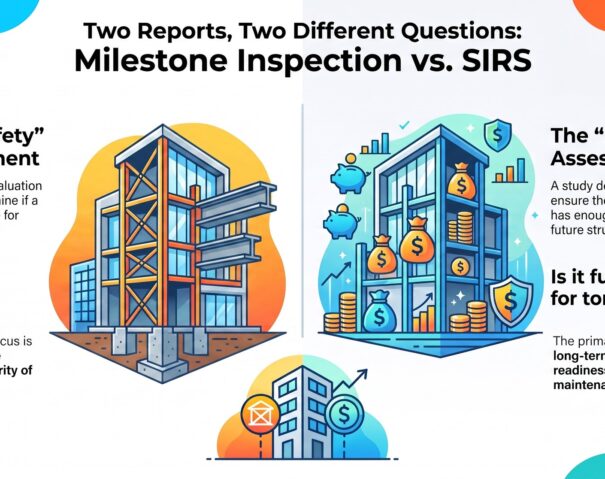
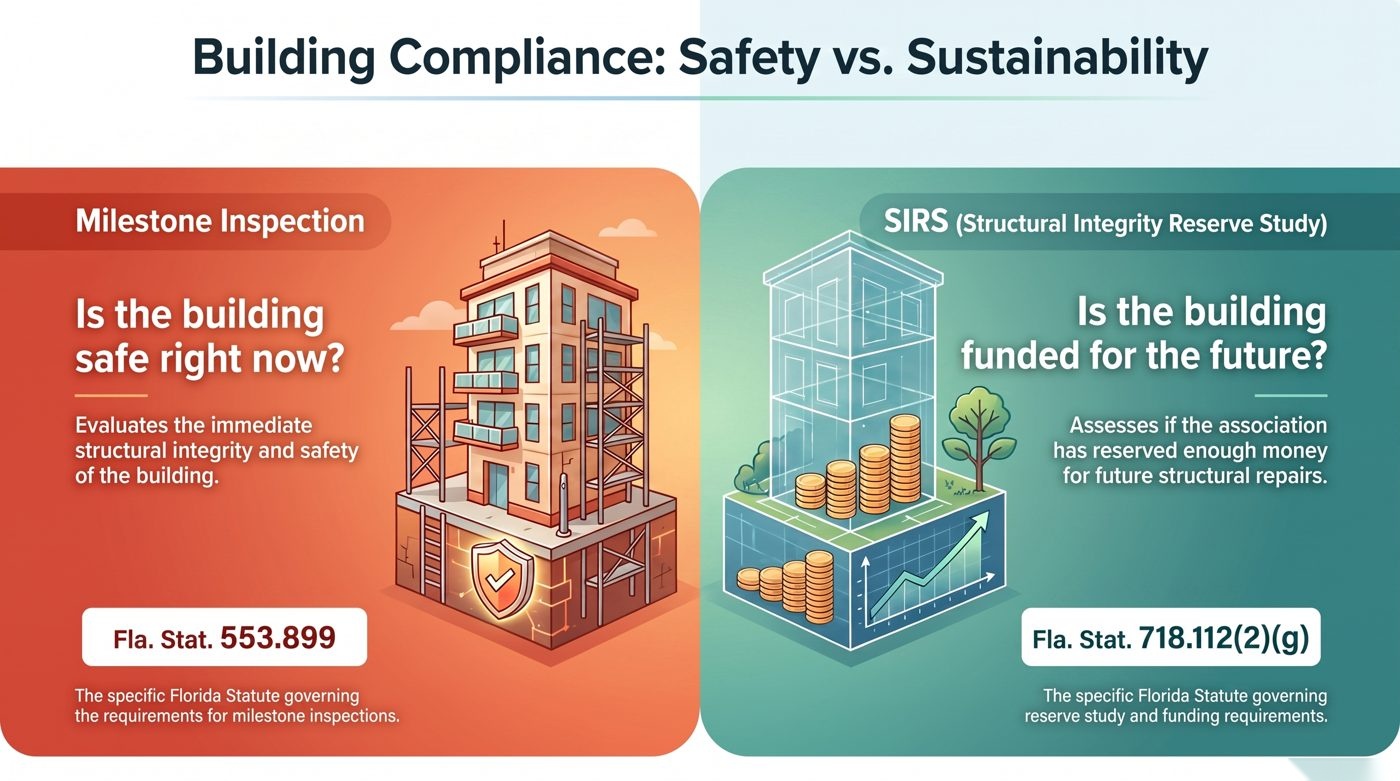
A milestone inspection is a separate, statutorily required structural safety inspection under Florida Statute 553.899, performed by a licensed engineer or architect, that examines a building for substantial structural deterioration on a schedule tied to the building’s age and coastal proximity. It answers a different question than the SIRS (whether the building is currently safe) which is why its findings and the SIRS’s reserve figures don’t always match (a topic covered in Two Reports, Two Very Different Numbers: Why Your SIRS and Milestone Inspection Don’t Match).
| Question It Answers | Who Prepares It | Governing Statute | What Happens If You Skip It | |
|---|---|---|---|---|
| Structural Integrity Reserve Study (SIRS) | How much money must the association reserve, and on what schedule, to fund repair or replacement of 8 structural and life-safety components? | A Florida-licensed engineer, licensed architect, CAI-credentialed Reserve Specialist (RS), or APRA-credentialed Professional Reserve Analyst (PRA) | Fla. Stat. 718.112(2)(g) (condominiums); Fla. Stat. 719.106 (cooperatives) | Unit owners cannot vote to waive or reduce reserves for the 8 covered components; missed SIRS/DBPR confirmation deadlines create statutory non-compliance and expose the board to enforcement inquiries and later special assessments. |
| Milestone Inspection | Is the building currently structurally sound and safe for its intended use right now? | A Florida-licensed engineer or architect (Phase 1; Phase 2 if substantial structural deterioration is found) | Fla. Stat. 553.899 | The local building official can pursue code-enforcement action; unresolved substantial structural deterioration findings can ultimately lead to a building being declared unsafe or uninhabitable. |
How Does Florida Law Affect What Your Board Must Do With a SIRS?
Florida law affects your board’s SIRS obligations at every stage, from who is legally allowed to prepare the report to what the board must file once it’s done. The current framework traces directly back to the June 2021 partial collapse of Champlain Towers South in Surfside, and the Legislature has amended it twice since the original 2022 law to adjust deadlines and funding flexibility.
For additional information about current inspection requirements and reserve funding regulations, read our guide to Florida condo laws.
-
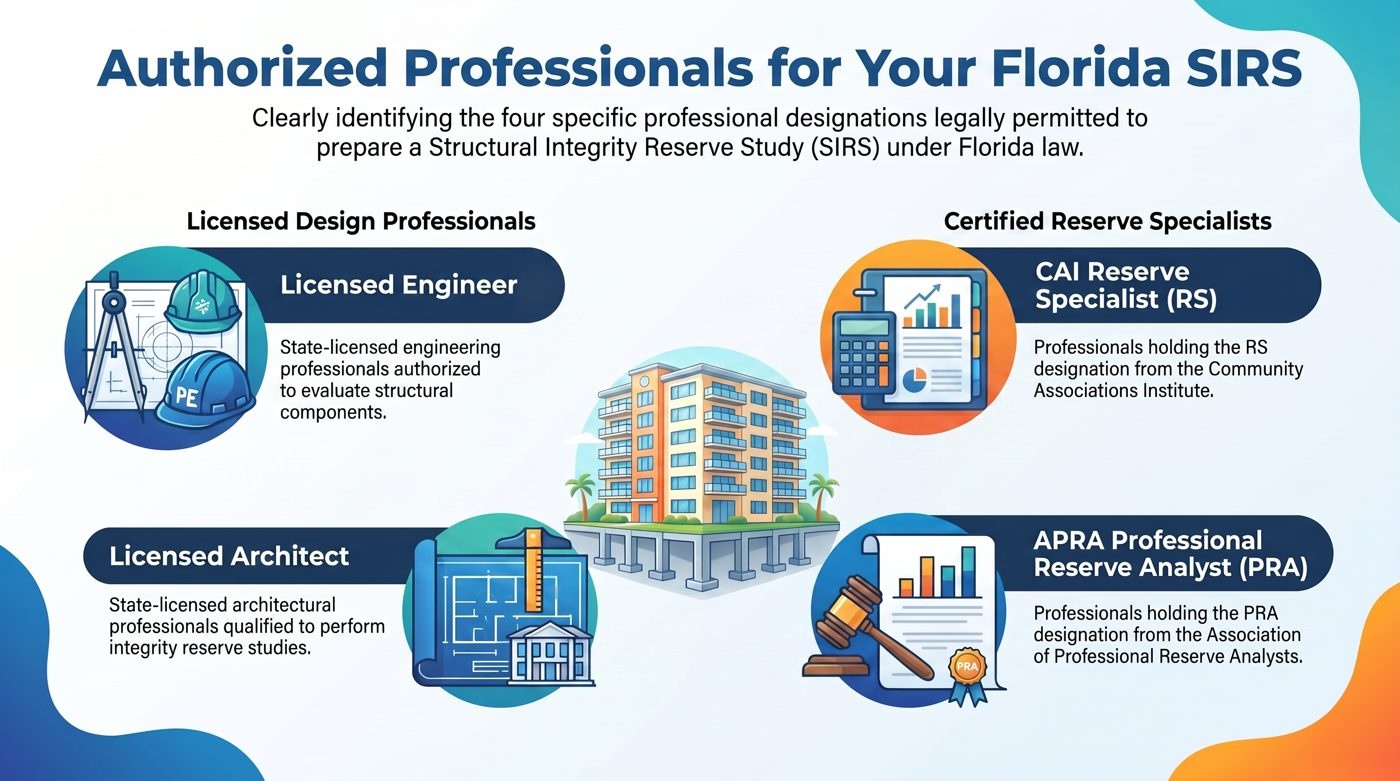
Who can prepare it: under Florida Statute 718.112(2)(g), the visual inspection portion must be performed or verified by a Florida-licensed engineer, a licensed architect, a Reserve Specialist (RS) credentialed by the Community Associations Institute, or a Professional Reserve Analyst (PRA) credentialed by the Association of Professional Reserve Analysts.
-
What triggers coverage: any additional component with a deferred-maintenance expense or replacement cost exceeding $25,675 (the current inflation-adjusted threshold under Florida Statute 718.112(2)(g), up from the original $25,000 figure set by HB 913) that would affect one of the eight required categories must also be included. We will cover this threshold in more detail in a companion article.
-
Deadline structure: for condominiums, the original statutory deadline for existing, non-developer-controlled associations to complete their first SIRS was extended by HB 913 to December 31, 2025. For cooperatives, the first-study deadline under Fla. Stat. 719.106 is December 31, 2024. Associations that have recently completed a required milestone inspection under Section 553.899 may, under HB 913, delay commissioning their SIRS for up to two consecutive budget years following that inspection: boards in that position should confirm their specific timeline with their engineer rather than assuming either deadline applies by default.
-
Funding flexibility: HB 913 also allows a board, without a unit-owner vote, to pause reserve contributions for up to two years if a building has been declared uninhabitable by the local building official, and permits funding through special assessments, loans, or lines of credit in addition to regular assessments.
What Do Skeptical Board Members Usually Get Wrong About SIRS?
The most common misconception is that a high SIRS reserve figure means the building is unsafe. It doesn’t: a SIRS measures long-term funding adequacy for eventual repair or replacement, not current structural safety, which is what the milestone inspection under Section 553.899 is for. A building can pass its milestone inspection with no findings of substantial structural deterioration and still carry a large SIRS funding requirement, simply because a component like waterproofing or roofing is approaching the end of its useful life on a normal replacement schedule.
Another frequent objection is that the board should be able to vote to reduce the reserve requirement the way associations used to before 2022. That option no longer exists for the eight SIRS-covered components on budgets adopted on or after December 31, 2024, regardless of how a membership vote would have gone. Boards that continue to include a waiver option for these specific line items on a budget ballot are creating a compliance problem for themselves, not offering members a genuine choice.
A third pushback is that hiring outside help to interpret the report is an unnecessary expense on top of what the SIRS itself already cost. In practice, the cost of a focused conversation with a licensed engineer about two or three flagged line items is small compared to the cost of either overreacting with an unnecessary special assessment or underreacting and missing a genuine funding gap (both outcomes are more expensive than the conversation that would have prevented them).
Summary
-
A SIRS is a legally mandated reserve-funding roadmap for eight structural and life-safety components, required under Florida Statute 718.112(2)(g) for buildings three or more habitable stories.
-
Once complete, unit owners cannot vote to waive or reduce reserves for the eight covered components on budgets adopted on or after December 31, 2024.
-
Officers and directors must sign an affidavit acknowledging receipt of the report, and a confirmation must be filed with DBPR within 45 days after the association receives the study.
-
For condominiums, the initial statutory deadline was extended by HB 913 to December 31, 2025. For cooperatives, the first-study deadline under Fla. Stat. 719.106 is December 31, 2024. An association that completes a milestone inspection may delay its SIRS for up to the 2 consecutive budget years after the inspection, and in no event may a SIRS be completed after December 31, 2026. Confirm your specific timeline with your engineer.
-
A large SIRS number does not mean the building is unsafe: it means a funding gap exists for future repair or replacement, which is a different question than the one a milestone inspection answers.
-
Boards that walk through the report component by component, rather than reacting to the total figure, make better and less expensive funding decisions.
Why Does Getting This Right Matter for Florida Buildings?
Getting this right matters because Florida’s SIRS framework exists specifically to prevent the kind of deferred, unrecorded structural risk that contributed to the Champlain Towers South collapse, and every board that treats its SIRS as a genuine funding mandate rather than a filing obligation is doing exactly what the law was written to accomplish.
South Florida’s coastal buildings face a faster deterioration timeline than most of the country because of salt exposure, humidity, and storm cycles, which is precisely why the eight required components and the ten-year update cycle were written the way they were. A board that reads its SIRS carefully in the first month, asks its engineer direct questions about the flagged line items, and funds accordingly is protecting both its building and, just as importantly, the owners who are counting on the board to have actually done this work.
Understanding and acting on a SIRS Report helps condominium boards make informed maintenance and financial decisions while addressing applicable Florida reserve requirements.
References / Bibliography
[1] Florida Legislature. Florida Statutes § 718.112: Bylaws. 2025. Online Sunshine.
[2] Florida Legislature. Florida Statutes § 553.899: Mandatory Structural Inspections for Condominium and Cooperative Buildings. 2025. Online Sunshine.
[3] Florida Legislature. Chapter 2025-175, Laws of Florida (formerly CS/CS/HB 913), Condominium and Cooperative Associations. 2025.
[4] Florida Legislature. Chapter 2022-269, Laws of Florida (Senate Bill 4-D). Special Session D, 2022.
[5] Florida Department of Business and Professional Regulation, Division of Florida Condominiums, Timeshares, and Mobile Homes. Guidance Regarding Structural Integrity Reserve Study (SIRS) Reporting Requirements. MyFloridaLicense.com.
[6] Florida Legislature. Florida Statutes § 719.106: Bylaws. 2025. Online Sunshine.
[7] National Institute of Standards and Technology (NIST). NCSTAR Investigation into the Partial Collapse of Champlain Towers South, Surfside, Florida. Technical findings released June 2026.
[8] Florida Building Commission. Florida Building Code, Building, 8th Edition (2023), Chapter 2, Definitions (“Habitable Story”).
Frequently Asked Questions About SIRS in Florida
What are Florida’s Condo SIRS Requirements, and which properties are exempt?
A Structural Integrity Reserve Study is required for Florida condominium or cooperative buildings that are three stories or higher. Exempt properties include single-family homes, duplexes, or buildings with fewer than three habitable stories, as determined by the Florida Building Code.
When must my association complete a SIRS, and how often?
For condominium associations that existed on or before July 1, 2022, and are controlled by unit owners, the first SIRS was due by December 31, 2025. An association that must also complete a milestone inspection by December 31, 2026 may complete both at the same time, but in no event may the study be completed after December 31, 2026. A residential condominium association must have a SIRS completed at least every 10 years. For cooperative associations, Fla. Stat. 719.106 sets the first-study deadline at December 31, 2024, with the same December 31, 2026 outer limit. Boards that have not yet completed theirs should confirm their specific deadline with their engineer or attorney.
What must be included in a SIRS report?
A proper SIRS report must visually inspect and list each structural component, such as roofing, electrical systems, waterproofing, and load-bearing walls, plus any other item over $25,000 (or the inflation-adjusted amount set by DBPR, whichever is greater) with its estimated remaining useful life, replacement cost, and a recommended annual reserve funding schedule.
How much does a SIRS cost in Florida?
Cost depends on the size, age, and complexity of your building. We provide a detailed proposal so your board can budget accurately before committing.
What happens if my association doesn’t complete its SIRS on time?
Failing to complete a required SIRS can expose board members to fiduciary liability and put the association out of compliance with Florida law, which can affect financing, insurance, and unit sales.
Who is qualified to perform a Structural Integrity Reserve Study?
A SIRS must be performed or verified by a Florida-licensed engineer, a licensed architect, or a reserve specialist or professional reserve analyst certified by the Community Associations Institute or the Association of Professional Reserve Analysts, under Section 718.112.
Need Help With Your SIRS? Get a Quote in 24 Hours