The $25,675 Rule Most Boards Get Wrong, Even When They Think They’re Covered

Author: Greg Batista, PE, CGC, SI, President of G. Batista Engineering & Construction
Last Updated: October 2026
A Structural Integrity Reserve Study (SIRS) always requires a reserve line item for the seven building components Florida law names outright, regardless of cost. For every other component, the SIRS requires a reserve line item only once the cost to replace or maintain it exceeds $25,675, and many Florida condo boards misjudge which components actually cross that line.
Some boards assume every major system in the building is automatically covered, only to find items like a pool deck, seawall, or elevator system left out because the projected cost fell under the threshold or the component does not fall into one of the categories the law requires. Others assume a component is excluded, only to discover it triggers a mandatory SIRS reserve line item because replacement costs in South Florida have pushed it past $25,675. This blog explains exactly which components trigger the requirement, which ones commonly get missed, and how a board in South Florida can read its own SIRS report correctly the first time.
Download the SIRS $25,675 Rule Guide (PDF)
Which Building Components Actually Trigger a SIRS Reserve Line Item?
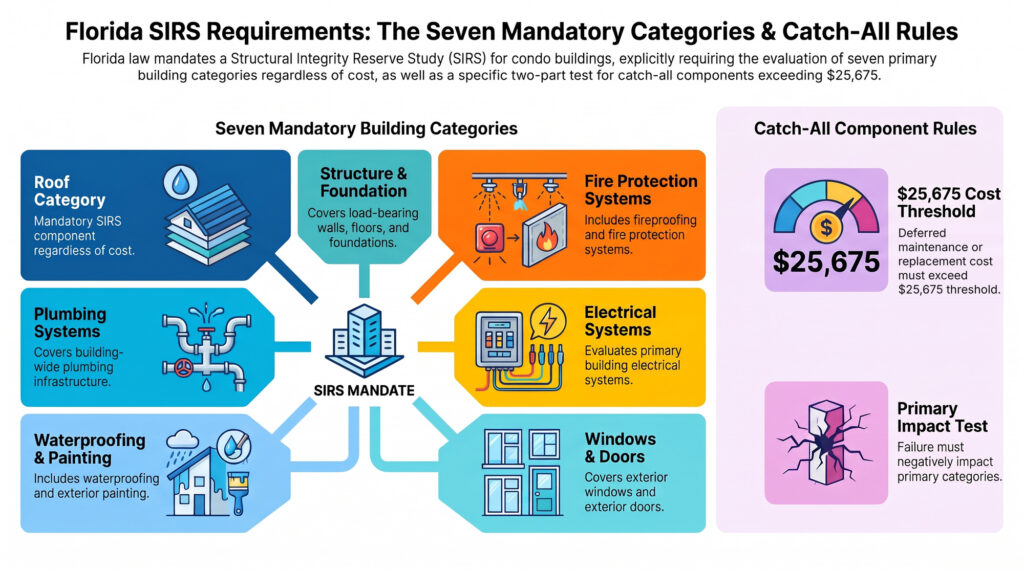
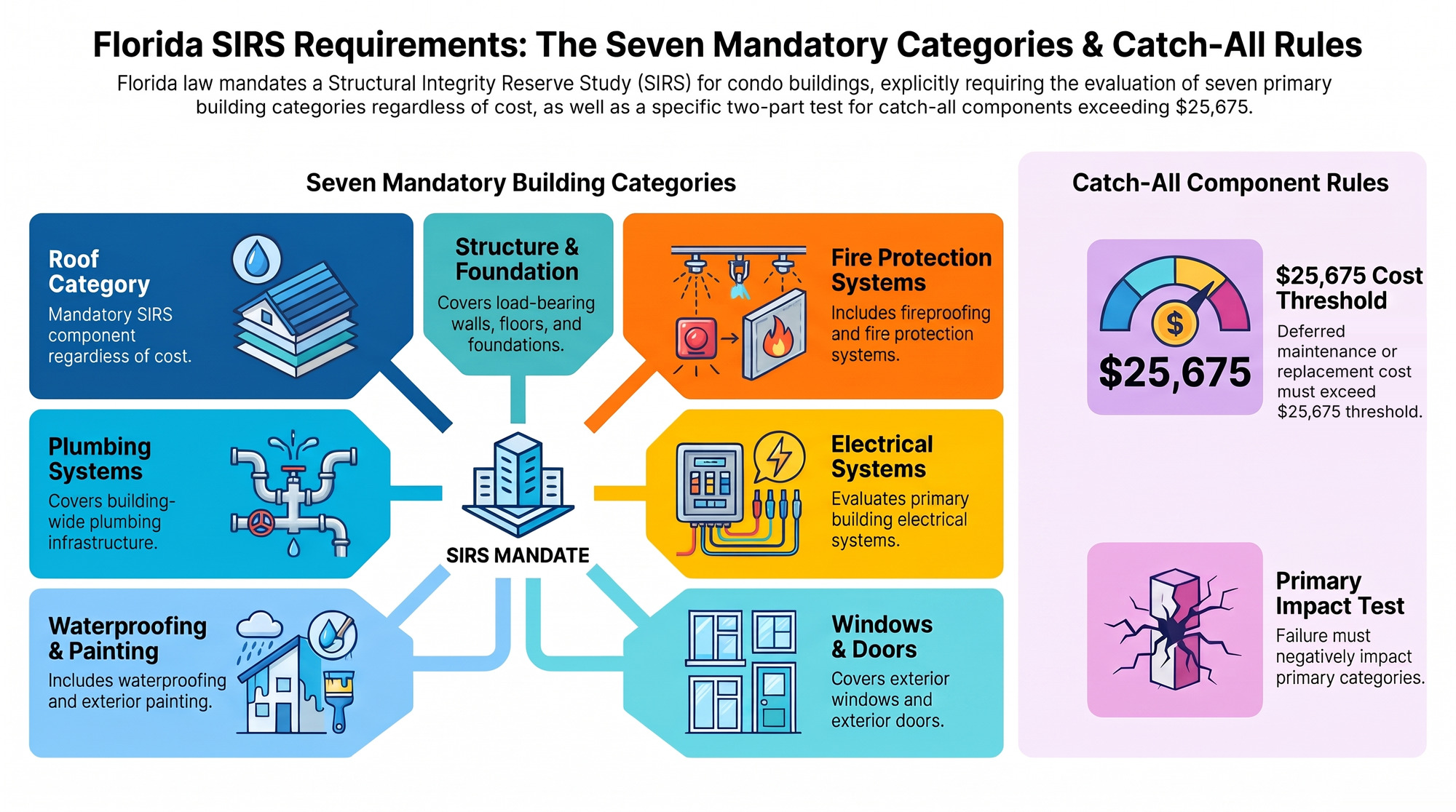
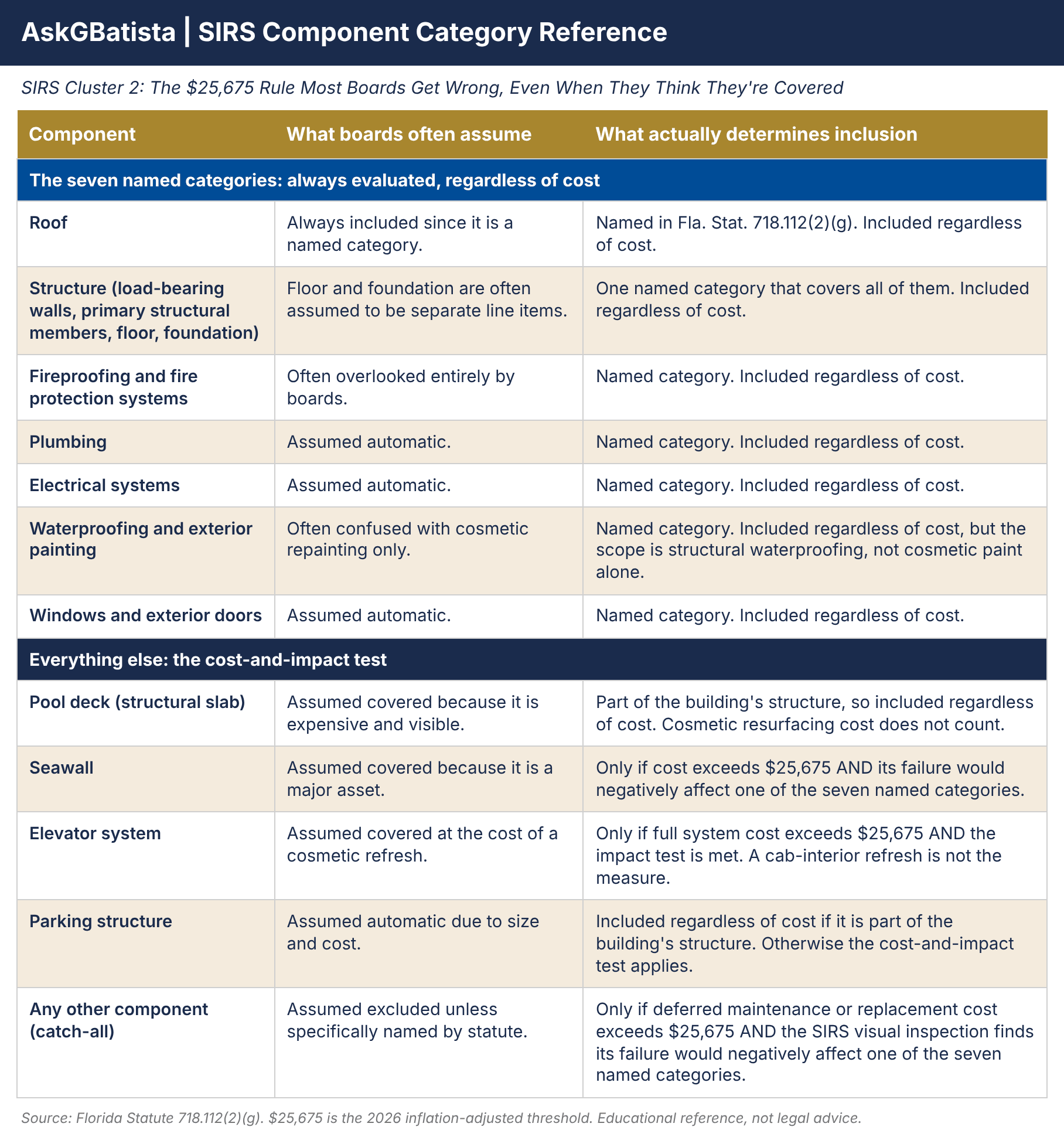
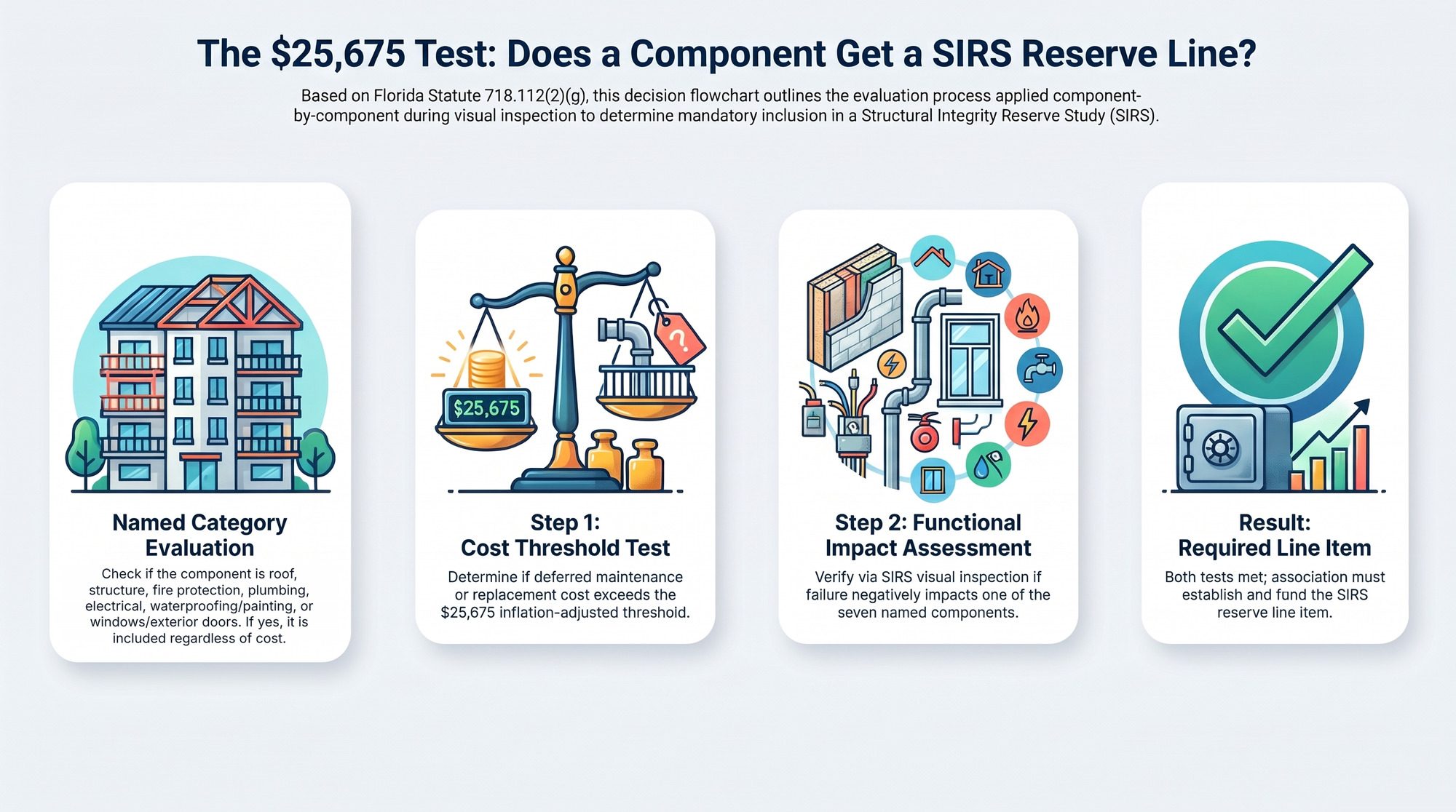
A building component triggers a mandatory SIRS reserve line item in one of two ways. If it falls within one of the seven categories Florida law names outright, it is included regardless of cost. If it does not, it is included only when its estimated deferred maintenance expense or replacement cost exceeds $25,675 (the statute says exceeds, not meets or exceeds, so a component at exactly $25,675 does not trigger) and the failure to replace or maintain it would negatively affect one of those seven named components. That figure is not arbitrary. Florida Statute 718.112(2)(g) sets a $25,000 base threshold, and the Division of Florida Condominiums, Timeshares, and Mobile Homes adjusts it for inflation each year under Section 718.112(2)(f)6; $25,675 is the Division’s published figure for 2026. It applies uniformly across the state, whether the building sits in South Florida’s coastal counties or further inland.
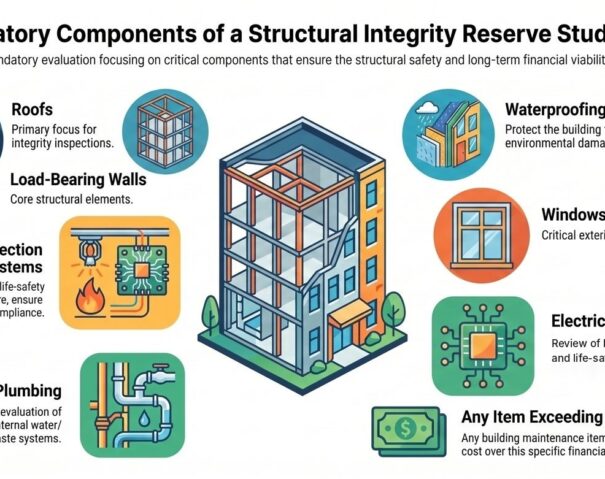
Florida law requires every condominium association’s SIRS to evaluate, at minimum, the following categories, provided the building has them:
- Roof
- Structure, including load-bearing walls and other primary structural members (this category absorbs the floor and foundation items that earlier versions of the statute listed separately)
- Fireproofing and fire protection systems
- Plumbing
- Electrical systems
- Waterproofing and exterior painting
- Windows and exterior doors
- Any other item that has a deferred maintenance expense or replacement cost exceeding $25,675 and whose failure to be replaced or maintained would negatively affect one of the seven components above, as determined by the visual inspection portion of the SIRS
That last category is where most confusion happens. It is a catch-all, and it is the reason two buildings with nearly identical layouts can end up with very different SIRS reserve lists. A pool deck, a seawall, an elevator system, or a parking structure is not automatically included just because it exists. It gets a SIRS reserve line item only if its deferred maintenance expense or replacement cost exceeds $25,675 and the visual inspection portion of the SIRS determines that failing to replace or maintain it would negatively affect one of the seven named components. If either condition is not met, the component may not appear in the SIRS at all, even though it is a real, visible, expensive part of the building.
This is the practical effect of the $25,675 rule. It is not a list of components the law names outright, beyond the seven core categories above. For everything else, it is a cost-and-impact filter applied component by component, building by building.
Why Does This Matter for Your Building?
Misreading which components triggered a SIRS reserve line item can leave a board underfunded for a major expense it assumed was already covered, or funding a category the law never required in the first place.
As a licensed Professional Engineer (PE), Certified General Contractor (CGC), and Special Inspector (SI), I have reviewed completed SIRS reports where boards were confident their pool deck or seawall was included in the reserve study, simply because it was an expensive, visible part of the property. In several of those cases, the component had been evaluated and excluded, either because its projected replacement cost fell under $25,675 at the time of the study, or because the engineer determined that its failure would not negatively affect one of the named structural components, which is the standard the statute requires for the catch-all category.
This creates three distinct risks for a board:
- Underfunding a real obligation. If a catch-all component like an elevator system crosses the $25,675 threshold, or a named component like the waterproofing membrane is undervalued, and it is missed during the SIRS process, whether through an incomplete inspection or a board’s own misunderstanding of what was covered, the association can face a special assessment later with no reserve funding in place to soften it.
- Overfunding a non-required category. On the other side, boards sometimes assume an expensive amenity, like a pool deck or parking garage, must be in the SIRS because of its cost alone, then over-allocate reserve contributions toward a line item the study never actually required, pulling funds away from categories that are required.
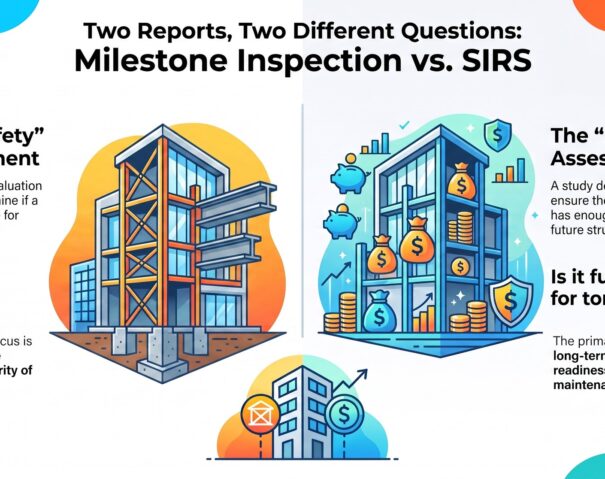
- Confusing SIRS scope with milestone inspection scope. A milestone inspection and a SIRS are separate reports asking separate questions. A component can pass a milestone inspection’s safety review and still trigger a SIRS reserve line item, or vice versa, because the two reports are not evaluating the same thing.
Getting the component list right the first time is not a compliance formality. It is the difference between a board that can explain its reserve numbers to owners with confidence and a board that gets blindsided by a special assessment for something it thought was already funded.
What Does This Look Like in a Real South Florida Building?
A pool deck that looks fine on the surface can still trigger a SIRS reserve line item if the concrete underneath has deteriorated past a cost threshold the board never checked.
The Board President of a mid-rise condominium in Fort Lauderdale called my engineering firm three weeks after her association’s completed SIRS report arrived. She had read through it twice and was confident about most of the line items, roof, plumbing, and electrical, all where she expected them. What confused her was the pool deck.
Her association had resurfaced the pool deck coating two years earlier, a cosmetic job that cost around eighteen thousand dollars. She assumed that number was roughly what the SIRS would reflect for future pool deck work, and she was surprised to see no line item for it at all in the report.
When we walked through the engineer’s findings together, the picture became clearer. The cosmetic resurfacing her board had paid for addressed the top wearing surface. It did not touch the structural concrete slab beneath the deck, the post-tension cables running through it, or the waterproofing membrane protecting the parking level below. When the SIRS engineer evaluated the pool deck as a structural component rather than a cosmetic surface, it fell squarely within the structure category the law names outright, and the projected replacement cost for that underlying structure came in well above the $25,675 threshold in any case once corrosion in the post-tension system and the age of the waterproofing were factored in.
So the pool deck was in the SIRS, just not under the label she expected, and not at the cost she remembered. The eighteen thousand dollar resurfacing job was a maintenance expense. The structural pool deck component, evaluated properly, was a reserve item well into six figures.
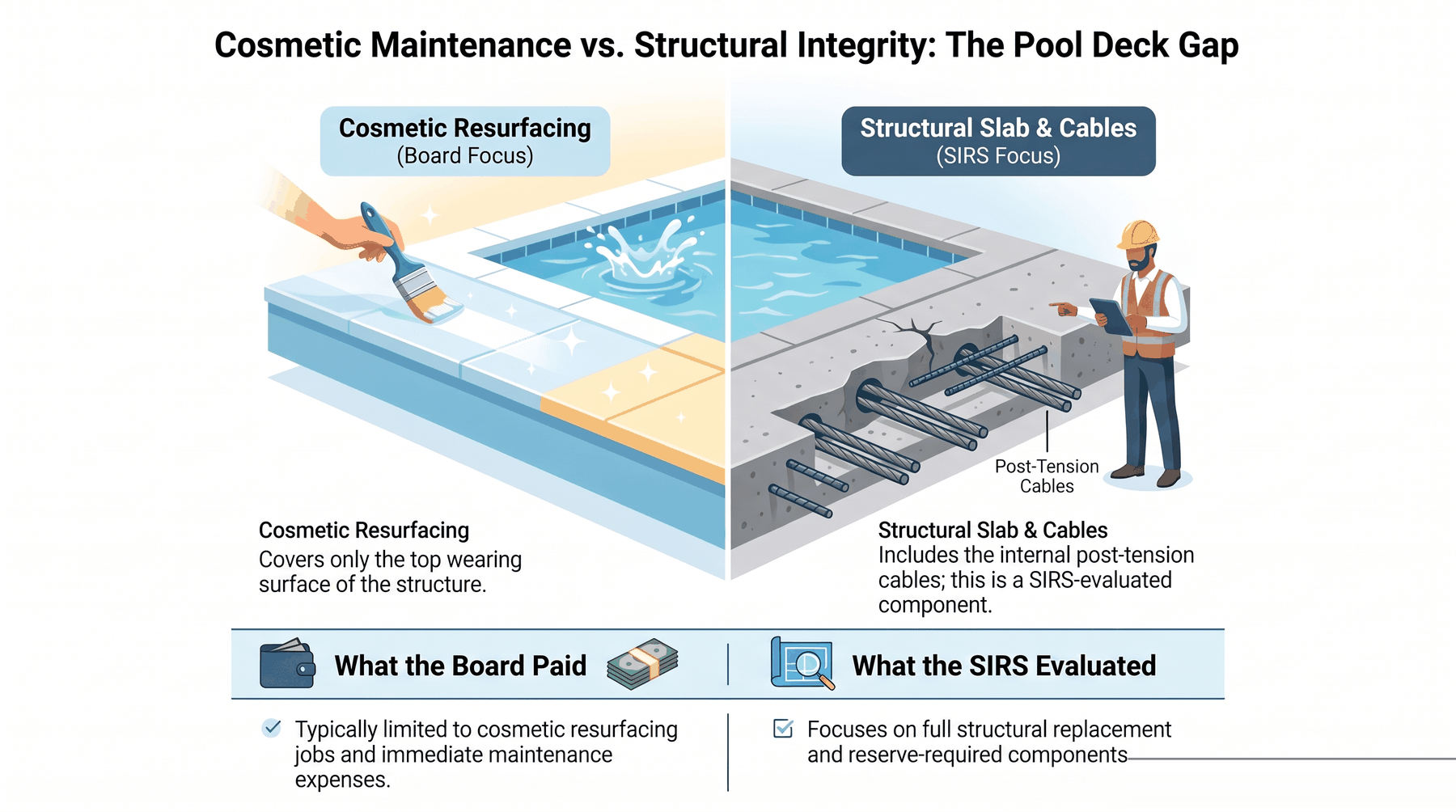
The Board Treasurer asked the obvious question. How do you avoid this? The answer was straightforward. Read the SIRS component by component, not by comparing it against what the association previously spent on cosmetic maintenance for that area. A coat of paint and a structural slab replacement are not the same conversation, even when they touch the same physical space.
After that conversation, the Board Treasurer asked the engineer to walk through the rest of the report the same way, item by item, checking which figures reflected structural replacement cost versus cosmetic or routine maintenance spending the board had done in the past. Two more line items came up in that review. The seawall figure matched what the board expected. The elevator modernization figure did not, for the same reason the pool deck hadn’t. The number in the SIRS reflected full system replacement, not the smaller cab-interior refresh the board had budgeted for two years earlier.
That board ended up adjusting its reserve contribution schedule once the correct figures were understood, avoiding a difficult scenario a few years down the line. The lesson traveled with them into every other line item in the report. The SIRS evaluates the structure underneath, not the finish on top.
What Do Condo Boards Usually Ask About This?
Does Every Pool Deck, Seawall, or Parking Structure Automatically Appear in a SIRS?
No, unless the component is itself part of the building’s structure (a pool deck slab over a parking garage, for example), these components only appear in a SIRS if their projected deferred maintenance expense or replacement cost exceeds $25,675 and the visual inspection portion of the SIRS determines that failing to replace or maintain them would negatively affect one of the seven named components. Each one has to be evaluated individually. A smaller building with a modest pool deck and a lower replacement estimate may see that component excluded entirely, while a larger building with the same amenity but a higher projected cost will see it included. There is no blanket rule that treats all pool decks, seawalls, or parking structures the same way across every association.
What Happens if a Component Was Excluded From Our SIRS but Later Turns Out to Need Major Repair?
If a component was correctly excluded because it fell under the $25,675 threshold at the time of the study, but conditions change and the repair cost later grows past that threshold, the board should have the SIRS updated to reflect the new estimate. Florida law requires SIRS updates at least every ten years, but a board is not prohibited from requesting an earlier reassessment if it has reason to believe a component’s condition or cost has changed materially. Waiting for the ten year cycle when a known issue is developing faster than that can leave the reserve underfunded in the meantime.
Can Our Board Add a Reserve Line Item for Something the SIRS Didn’t Require?
Yes, a board can voluntarily fund a reserve line item beyond what the SIRS legally requires, and many boards choose to do this for high-visibility amenities even when the statutory threshold was not met. This is a budgeting decision, not a compliance requirement. The SIRS sets the legal floor for what must be funded. It does not prevent a board from being more conservative and setting aside additional reserves for components it wants extra protection on, provided the association’s governing documents allow that level of board discretion.
Why Did Our Milestone Inspection Not Mention Some of the Items in Our SIRS?
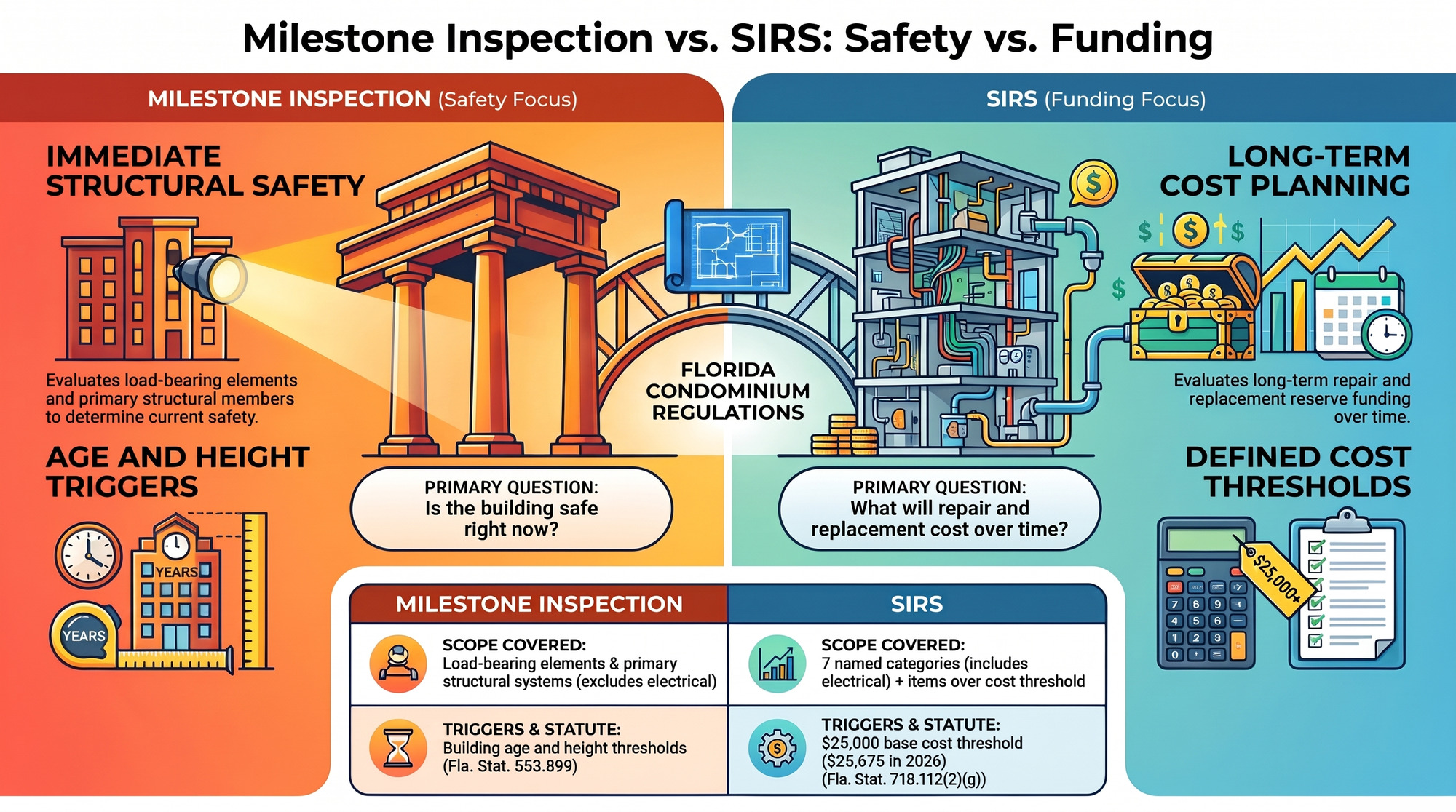
A milestone inspection and a SIRS ask different questions, so it is common and expected for items to appear in one report and not the other. The milestone inspection is a life safety evaluation of the building’s load-bearing elements and primary structural members and systems; it does not cover electrical systems. The SIRS is a long-term funding evaluation of specific components tied to a dollar threshold. A component can be structurally sound enough to pass a milestone inspection and still generate a large reserve line item in the SIRS because its replacement cost, not its current safety condition, is what the SIRS threshold measures.
What Do These Terms Actually Mean?
Structural Integrity Reserve Study (SIRS)
A Structural Integrity Reserve Study is a Florida-mandated evaluation, performed or verified by a licensed engineer, licensed architect, or certified reserve specialist or professional reserve analyst, that identifies specific building components and calculates the reserve funding an association must maintain for their eventual repair or replacement. It applies to condominium and cooperative associations statewide for buildings three habitable stories or higher and is separate from, though sometimes coordinated with, the milestone inspection process.
Reserve Component
A reserve component is any building system or element that a SIRS has determined requires a dedicated funding line item either because it falls within one of the seven categories Florida law names outright, or because its projected deferred maintenance expense or replacement cost exceeds the inflation-adjusted statutory threshold, currently $25,675, and its failure would negatively affect one of those named components. Not every physical part of the building qualifies as a reserve component under this definition.
Deferred Maintenance Expense
A deferred maintenance expense refers to the projected cost of repairing or replacing a component if that work is delayed rather than addressed proactively. In the SIRS context, this figure is one of the two cost measures, alongside straightforward replacement cost, that engineers use to determine whether a component crosses the $25,675 threshold.
Milestone Inspection
A milestone inspection is a separate Florida-mandated structural and life safety review required for condominium and cooperative buildings that meet certain age and height thresholds. It evaluates whether the building is currently safe for continued occupancy and is distinct from the SIRS, which evaluates long-term reserve funding needs.
How Does Florida Law Affect This?
Florida Statute 718.112(2)(g) sets the list of required SIRS component categories and a $25,000 base threshold for the catch-all category. The Division of Florida Condominiums, Timeshares, and Mobile Homes adjusts that threshold for inflation each year and posts the new figure by February 1; the 2026 figure is $25,675. Associations should confirm the current figure with their SIRS provider or on the Division’s website rather than assuming it stays fixed year over year.
A few specific legal points shape how this applies to South Florida buildings:
- The threshold is statewide, not regional. A building in Broward County and a building in a non-coastal Florida county apply the same $25,675 figure, though coastal exposure, salt air, and humidity often push South Florida components toward higher replacement cost estimates, making it more likely a given component crosses the threshold here than in less exposed markets.
- SIRS updates are required at least every ten years. Associations should treat the SIRS as a document that ages, not a one-time report, particularly for components sitting close to the threshold at the time of the last study.
- SIRS deadlines run on two separate tracks. Associations required to complete a milestone inspection on or before December 31, 2026 may complete their SIRS at the same time as that inspection, but in no event later than December 31, 2026. The general SIRS deadline of December 31, 2025 applied to associations existing on or before July 1, 2022 that are not on that milestone track, and that earlier deadline has already passed. Separately, an association that has completed a milestone inspection may delay a required SIRS for no more than the two budget years immediately following that inspection so it can focus its resources on the milestone repairs. Boards should confirm with their engineer or association attorney which track applies to their specific building before assuming either date controls their situation.
- Component evaluation requires a licensed professional. The determination that a component’s failure would negatively affect the named structural components, which controls whether the catch-all category applies, must come from the visual inspection portion of the SIRS, not from board judgment alone. Florida law requires the SIRS, including that visual inspection, to be performed or verified by an engineer licensed under Chapter 471, an architect licensed under Chapter 481, or a person certified as a reserve specialist or professional reserve analyst by the Community Associations Institute or the Association of Professional Reserve Analysts. A milestone inspection performed within the past five years may be used in place of the visual inspection portion if it meets the statutory requirements.
What Do Skeptical Readers Usually Get Wrong?
Isn’t the $25,675 Figure Just a Suggestion, Not a Hard Rule?
No, it is a statutory threshold, not a guideline a board can interpret loosely. Florida Statute 718.112(2)(g) sets this figure ($25,000 at the statutory base, adjusted annually by the Division) as the cost line that determines whether a component outside the seven named categories legally requires a dedicated SIRS reserve line item. A board cannot decide on its own that a component just under the threshold should still be excluded, or that one just over it should be treated as optional. The determination sits with the licensed engineer, architect, or certified reserve professional conducting the study, based on documented cost estimates and the negative-impact standard the law sets out.
If Our SIRS Missed a Component, Can We Just Add It Ourselves Without Redoing the Whole Study?
Not reliably, because adding a component after the fact without a proper engineering evaluation means the association has no documented, defensible cost basis for that reserve line item. A board can request a supplemental review or an update from its SIRS provider focused on the specific component in question, and this is often faster and less expensive than a full study. What a board should avoid is estimating a figure internally and inserting it into the reserve schedule without professional evaluation, since that leaves the association without the documentation a proper SIRS provides if the number is ever questioned.
Doesn’t a High-Cost Amenity Like a Pool Deck or Elevator Always Get Included Automatically?
No, cost alone does not automatically qualify a component. The component either has to fall within one of the seven named categories, or its failure has to negatively affect one of those named components, which is the standard the statute requires for the catch-all category. A pool deck’s cosmetic surface, for example, is unlikely to trigger a reserve line item on its own, while the structural slab beneath it might, depending on condition and projected replacement cost. This is exactly the kind of distinction that trips up boards reading a completed SIRS report for the first time, and it is worth confirming with the engineer who conducted the study rather than assuming based on the component’s price tag.
Bullet Summary
- A component triggers a mandatory SIRS reserve line item if it falls within one of the seven statutory categories, regardless of cost. Any other component triggers one only when its projected deferred maintenance expense or replacement cost exceeds $25,675 and the SIRS visual inspection determines that its failure would negatively affect one of those named components.
- High-visibility, high-cost amenities like pool decks, seawalls, and elevator systems are not automatically included in a SIRS. Unless it is part of the building’s structure, each must independently meet the cost and negative-impact standard.
- A component’s cosmetic maintenance cost is not the same as its structural replacement cost. Boards should evaluate reserve items based on what the SIRS engineer actually assessed, not on prior maintenance spending.
- A milestone inspection and a SIRS ask different questions, so components can appear in one report and not the other without contradiction.
- SIRS deadlines run on two tracks in Florida. Associations with a milestone inspection due on or before December 31, 2026 may complete the SIRS with that inspection, but never later than December 31, 2026; the general deadline of December 31, 2025 for associations not on that track has already passed.
- Boards can voluntarily fund components beyond what the SIRS legally requires, but this is a budgeting choice, not a compliance obligation.
Why Does Getting This Right Matter for Florida Buildings?
Reading a SIRS accurately, component by component, is what allows a South Florida board to plan its reserve contributions with confidence instead of being caught off guard by an unexpected expense for something it assumed was already covered.
This is exactly the kind of detail covered at a higher level in our guide to understanding your SIRS report and planning the next steps, written for boards seeing a completed SIRS for the first time. The $25,675 threshold is one of several moving parts a board has to understand correctly, alongside how the reserve numbers were built, what the report assumes is covered versus assumed but not covered, and what the association’s broader obligations look like once the report is in hand. Getting the component-level detail right here is part of getting the bigger picture right there.
For a South Florida condominium board, the value of understanding this rule is not academic. Coastal exposure means components here are more likely to sit near or above the $25,675 threshold than in less exposed parts of the state, which makes an accurate, professionally evaluated SIRS more consequential here than in almost any other part of Florida.
Questions about what belongs in your reserve study? Our structural integrity reserve study page explains the process, what gets evaluated, and how to request a quote.
References / Bibliography
- Florida Legislature. Florida Statutes § 718.112: Bylaws. The 2025 Florida Statutes. https://www.flsenate.gov/Laws/Statutes/2025/718.112
- Florida Legislature. Florida Statutes § 553.899: Mandatory Structural Inspections for Condominium and Cooperative Buildings. The 2025 Florida Statutes. https://www.flsenate.gov/Laws/Statutes/2025/553.899.
- Florida Department of Business and Professional Regulation, Division of Florida Condominiums, Timeshares, and Mobile Homes. Structural Integrity Reserve Study (SIRS) Guidance and Resources. MyFloridaLicense.com. https://www.myfloridalicense.com/.
- Florida Building Commission. Florida Building Code, Eighth Edition (2023). https://floridabuilding.org/.
- American Concrete Institute. ACI CODE-562-21: Code Requirements for Assessment, Repair, and Rehabilitation of Existing Concrete Structures and Commentary. Farmington Hills, MI: American Concrete Institute, 2021.
- International Code Council. International Existing Building Code (IEBC), 2024 Edition. Washington, DC: International Code Council, 2024.
- National Institute of Standards and Technology. NCST Advisory Committee and Champlain Towers South Investigation. Gaithersburg, MD: U.S. Department of Commerce, National Institute of Standards and Technology.
- Community Associations Institute. Structural Integrity Reserve Study Resources. Falls Church, VA: Community Associations Institute. https://www.caionline.org/.
Need Help With Your SIRS? Get a Quote in 24 Hours