What One Year of Delay Actually Added to This Association’s Reserve Bill

Author: Greg Batista, PE, CGC, SI, President of G. Batista Engineering & Construction
Last Updated: November 2026
One year of delay on a Structural Integrity Reserve Study (SIRS) adds cost in three ways: fewer years remain to fund each component, deferred problems tend to grow while the study waits, and later pricing replaces older estimates. Meanwhile the association’s duty to fund reserves keeps running whether or not the study exists. For a board, the practical question is how much larger the annual reserve contribution, or a condo special assessment to catch up, becomes with each year of delay. This article walks through a South Florida example, shows the reserve math in plain numbers, and explains how the December 31, 2025 and December 31, 2026 deadline tracks fit in. G. Batista Engineering & Construction wrote it to help boards make a clear decision with accurate information.
Download the SIRS Cost of Delay Guide (PDF)
What Does One Year of SIRS Delay Actually Cost a Condo Association?
How Does One Year of Delay Change the Reserve Math?
One year of delay removes one year from the funding runway, so the same dollar amount has to be collected over fewer years. Under Florida Statute 718.112(2)(g)4.a, the SIRS identifies each covered component, its remaining useful life, and its estimated replacement cost, and under 718.112(2)(f)2.a the association funds reserves for those items. When a component’s remaining life shrinks, the annual contribution rises.
Here is the simple version. Assume a $310,000 component and straight-line arithmetic, with no inflation, no interest and no existing reserve balance:
- 10 years remaining: $310,000 divided by 10 equals $31,000 per year.
- 9 years remaining: $310,000 divided by 9 equals about $34,444 per year, an increase of about 11 percent.
- 5 years remaining: $310,000 divided by 5 equals $62,000 per year.
- 4 years remaining: $310,000 divided by 4 equals $77,500 per year, an increase of $15,500 per year, or 25 percent.
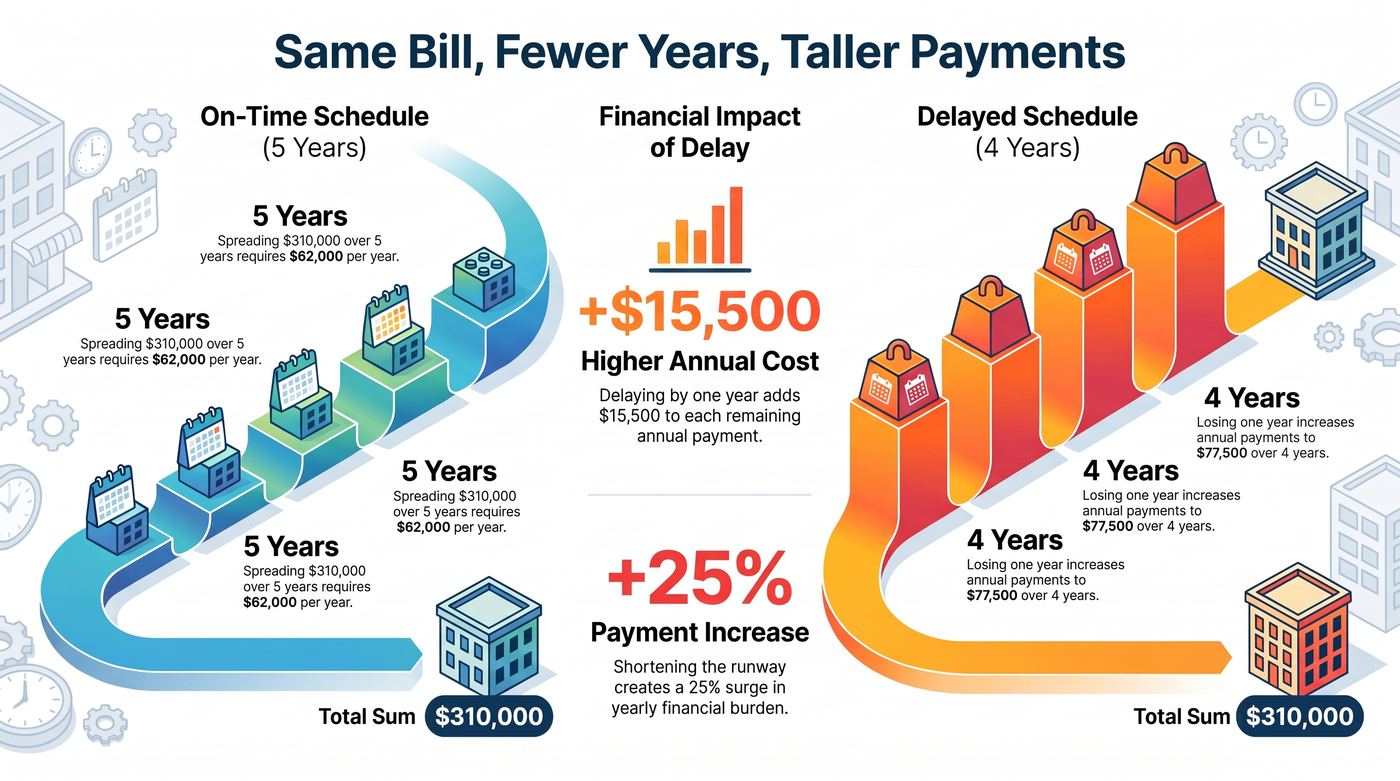
The closer a component is to the end of its life, the more painful one lost year becomes. The figure and table below show the same pattern at three stages.
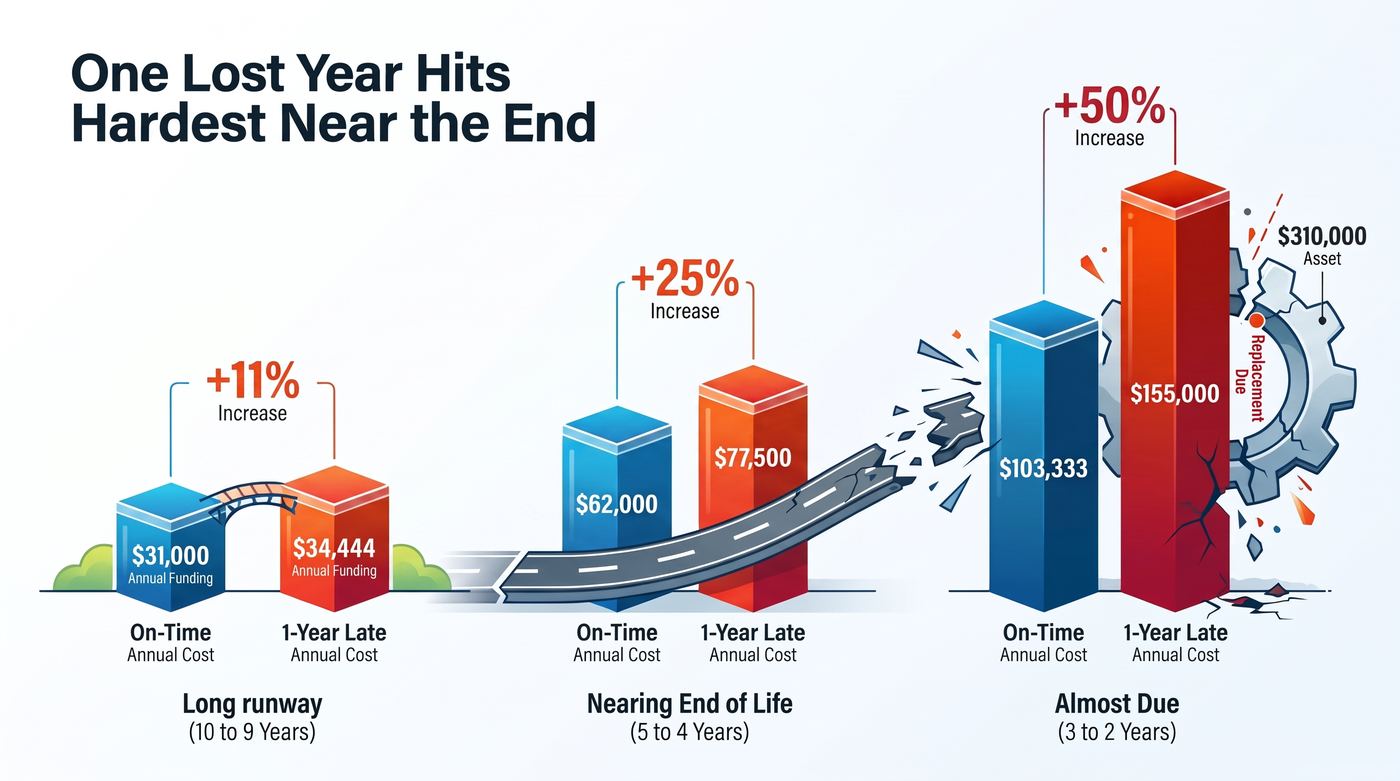
| Component situation | Annual amount on time | Annual amount one year late | Added per year |
|---|---|---|---|
| Long runway (10 years down to 9) | $31,000 | About $34,444 | About $3,444 (11%) |
| Nearing end of life (5 years down to 4) | $62,000 | $77,500 | $15,500 (25%) |
| Almost due (3 years down to 2) | About $103,333 | $155,000 | About $51,667 (50%) |
Straight-line math, simplified. A real SIRS may use a baseline funding method that keeps the reserve balance above zero, so actual numbers will differ. Your SIRS preparer sets the schedule for your building.
What Else Gets More Expensive While the SIRS Waits?
Delay adds cost beyond the division problem, because a building keeps aging and the market keeps moving while the study sits unfinished. These are the usual drivers boards run into:
- Deferred repairs tend to grow. A small, fixable issue left alone often becomes a larger repair or a full replacement, which is why the study’s early findings matter.
- Estimates are priced at study time. A SIRS reflects costs when it was prepared. The statute says the association may adjust estimates annually, it does not require it, so a late study simply prices the work later.
- The decision window narrows. Fewer years remaining means fewer options for phasing work, financing it or scheduling it around the budget cycle.
- Owners get less notice. A larger assessment with a shorter runway gives owners less time to plan, and that is where trust problems begin.
How Does the Gap Add Up Across Several Components and Many Owners?
A SIRS covers several components at once, so a one-year delay is felt across the whole schedule rather than in one line item. The total depends on how many components are near the end of their life, and a building with two or three of them can see the added annual amount multiply quickly.
Consider a hypothetical building with three components, each priced at $310,000 and each one year behind schedule:
- Roof with 5 years down to 4: adds about $15,500 per year.
- Waterproofing with 5 years down to 4: adds about $15,500 per year.
- Paving with 10 years down to 9: adds about $3,444 per year.
Together that is roughly $34,444 more per year across the three, before any inflation or interest. For a 100-unit association, that works out to about $344 more per unit per year on average. Actual unit shares follow each association’s documents and the percentages assigned to each unit, so owners will not all pay the same amount.
The point of the exercise is not to predict your number. It is to show why boards should ask the preparer for two views: what the schedule looks like today, and what it would have looked like a year earlier. That comparison turns an abstract conversation about delay into a concrete one that owners can follow.
Why Does a One-Year Delay Matter for Your Board’s Budget?
A one-year delay matters because it turns a manageable annual plan into a catch-up problem, and the board owns that problem. As a licensed Professional Engineer (PE), Certified General Contractor (CGC), and Special Inspector (SI), I see the same pattern in the field: associations that start earlier have more choices, and associations that start later pay more for fewer of them.
- Financial: Contributions per year rise as remaining life falls, and a larger catch-up can end up as a condo special assessment. The study itself does not create the gap, it only reveals it.
- Planning: Under 718.112(2)(g)4.c the study must be updated to reflect the funding method the association selects, so the board should treat it as a working schedule rather than a one-time report.
- Owner trust: Explaining a larger number is easier when owners can see that the board acted promptly once the facts were in hand.
What Does a One-Year SIRS Delay Look Like in a Real South Florida Building?
The study was never the expensive part; the year of waiting and the years of deferral before it were. What follows is an example from my practice, with identifying details left out so no association can be recognized.
Identifying details are left out, and numbers are rounded and simplified.
My engineering firm was called by the Board President of a residential condominium in South Florida in the spring after the board had skipped its 2025 study. The Treasurer had argued that nothing had changed in the building, so the study could wait one more budget cycle. When I walked the roof with the board on a warm May afternoon, the picture was different from what they expected.
Years earlier, a roughly $40,000 repair had been recommended and deferred. In the intervening years the problem spread, and by the time we looked at it the right answer was a full replacement estimated at $310,000. That escalation built up over the deferral years, not in one year, and it is exactly the kind of change a timely study would have caught sooner.
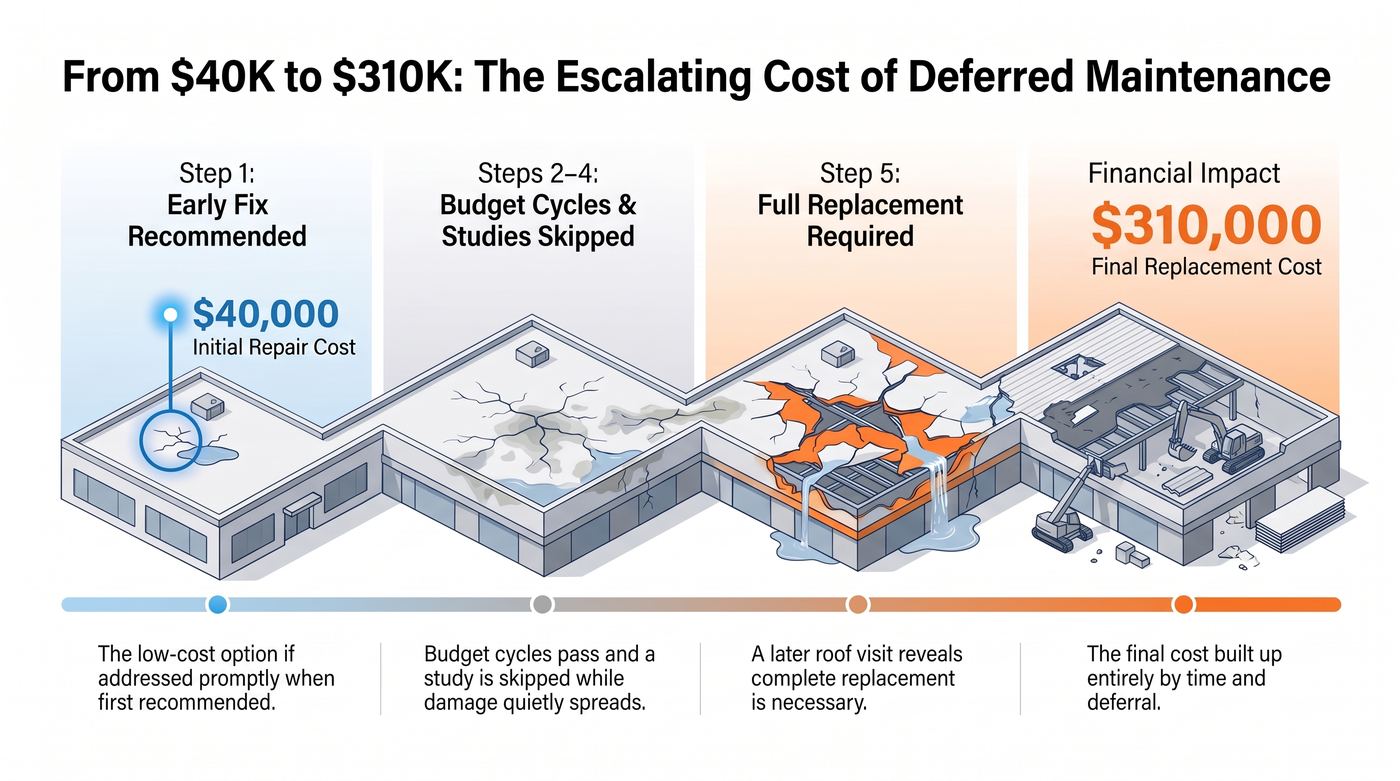
The SIRS showed about four years of remaining life on the roof. Had the study been completed on time, the same component would have shown about five years. On the simple math, that is $62,000 per year versus $77,500 per year, a difference of $15,500 each year for that one component alone.
| Scenario | Years remaining | Annual amount | Difference per year |
|---|---|---|---|
| SIRS completed on time | About 5 | $62,000 | Baseline |
| SIRS completed one year late | About 4 | $77,500 | $15,500 more (25%) |
Straight-line math on a $310,000 replacement, with no inflation, interest or existing reserves.
The board did not panic. With counsel advising on which owner approvals applied, the board phased the funding over two budget years and asked the preparer to update the funding schedule. The Treasurer told the room that waiting had been the wrong call. The Board President put it plainly: the study was the cheapest part of the whole story.
Looking back, the board’s real mistake was not a single decision. It was a habit of treating each budget cycle as a chance to postpone the question. Each postponement felt small and each one was reasonable on its own, which is why the pattern is so common. The owners, once they saw the roof photos and the two schedules side by side, understood the situation faster than the board had expected.
The building’s property manager helped the board set up a simple routine afterward: a standing agenda item each quarter to review the study, the reserve balances and any open repair recommendations. That routine cost almost nothing, and it gave the board a record showing it had acted promptly once the facts were known. Boards that build this habit tend to avoid repeating the same story.
What Do Condo Boards Usually Ask About Delaying a SIRS?
Does delaying the SIRS also delay our duty to fund reserves?
No. The duty to fund reserves under 718.112(2)(f)2.a does not pause because the study is late. A board that waits for the study before contributing may find itself behind on both fronts. Ask your association’s counsel what interim funding makes sense while the study is completed.
Can we still wait until December 31, 2026?
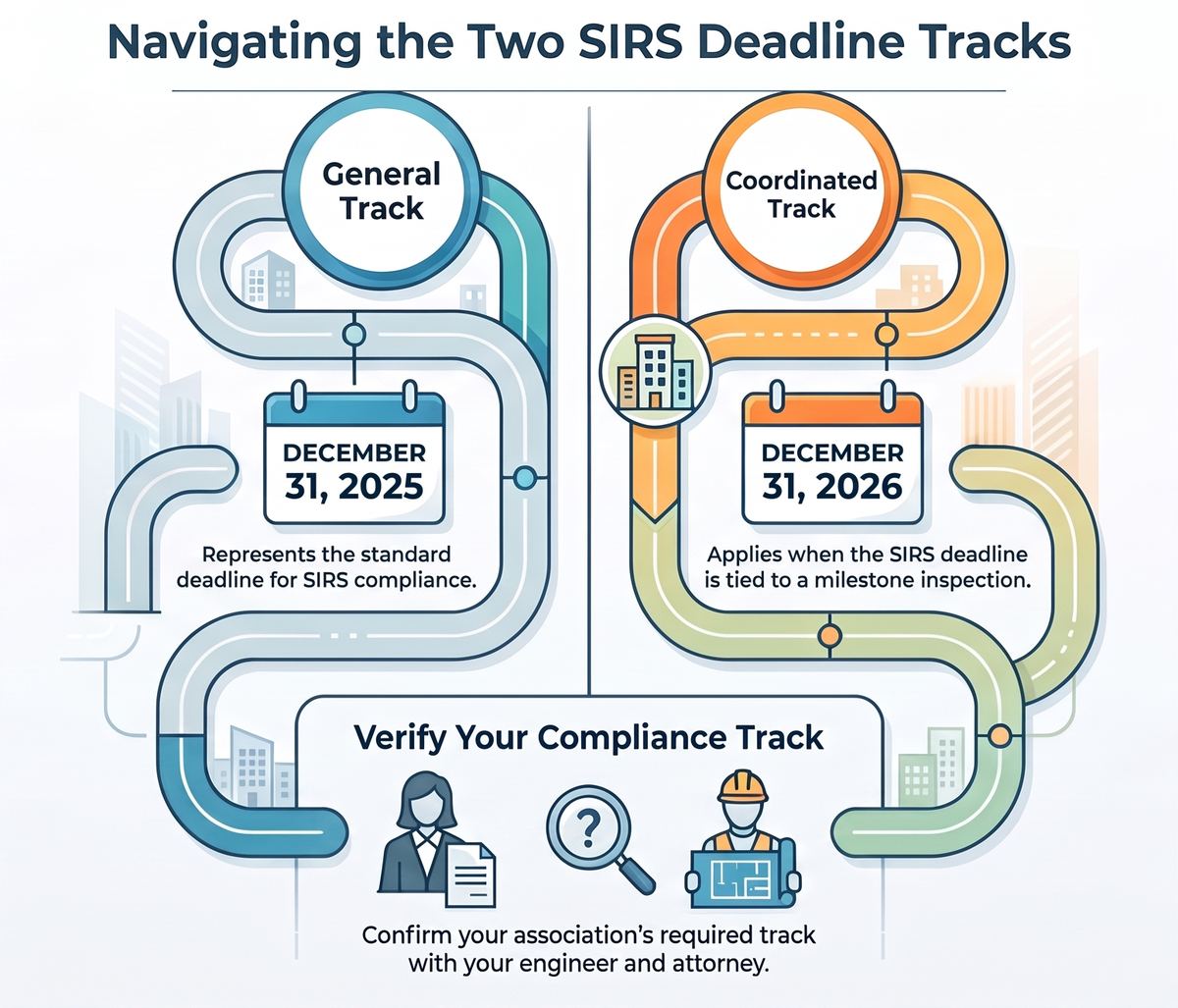
Only if your association is on the coordinated track, meaning it is tied to a milestone inspection under 718.112(2)(g)7. Associations outside that track generally faced the earlier December 31, 2025 deadline. Confirm which track applies with your engineer and your attorney before relying on the later date.
Will a delayed SIRS always show a bigger number?
Rarely does it show a smaller one. Remaining life only shrinks with time, and prices rarely fall, so the annual figure tends to rise. The exact change depends on the component, the funding method and your existing reserve balance.
What should a board do the week it realizes the SIRS is late?
Engage a qualified preparer as described in 718.112(2)(g)3.a, then gather prior reports, repair records and reserve balances so the study can move quickly. Tell owners that the board is acting, and ask counsel what to document in the meantime. Quick, calm action is the strongest position a board can take.
Can we spread out the catch-up?
Often yes, within limits. Funding methods under 718.112(2)(f)2.c(I) generally need a majority vote of the total voting interests, and an updated study may be needed under 718.112(2)(g)4.c if conditions have changed. Your counsel and your preparer can confirm what applies to your documents.
What Do These Terms Actually Mean?
These four terms come up in almost every conversation about delay, and each one has a plain meaning.
- Remaining useful life: The estimated number of years a component can keep doing its job before replacement.
- Deferred maintenance: Repair or upkeep that was recommended or needed but postponed.
- Annual reserve contribution: The amount an association sets aside each year toward a component’s future replacement.
- Funding runway: A plain-English phrase for the years left to collect the money. This is not a statutory term.
How Does Florida Law Treat a Late or Delayed SIRS?
Florida law treats the SIRS as a requirement with firm deadlines and only narrow pauses, so a board should not assume a late study is excused. The main rules are in Florida Statute 718.112, with related provisions in 553.899 and the 2025 amendments in CS/CS/HB 913 (Chapter 2025-175).
- General deadline: The standard SIRS deadline was December 31, 2025.
- Coordinated track: Associations tied to a milestone inspection may coordinate and use December 31, 2026.
- No waiver: The requirement to complete the study cannot be waived by the board.
- Narrow pauses: A milestone-related pause under 718.112(2)(f)2.e requires a majority vote, and a natural-emergency pause is addressed in 718.112(2)(f)2.d. Neither is a general permission to wait.
- Catch-up financing: Options for funding shortfalls are addressed in 718.112(2)(f)2.c(II).
- Threshold: The current inflation-adjusted threshold referenced in the statute is $25,675.
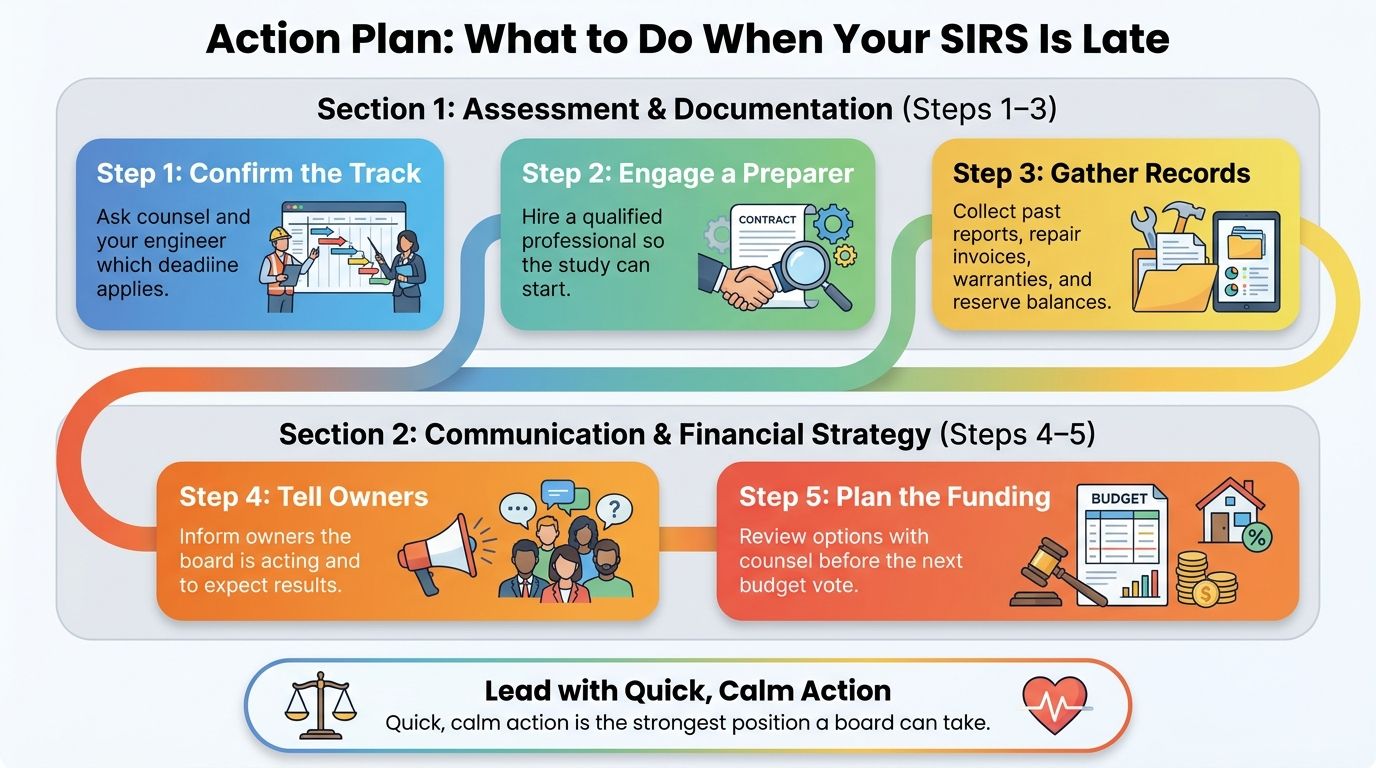
In practical terms, a board that discovers it is behind can take these steps in order. None of them replaces legal advice, and each should be confirmed against your own governing documents:
- Confirm the track. Ask counsel and your engineer whether the association is on the general track or the coordinated track.
- Engage a preparer. Hire a qualified professional under 718.112(2)(g)3.a so the study can begin.
- Gather records. Collect past reports, repair invoices, warranties and current reserve balances.
- Communicate with owners. Tell owners the board is acting and when to expect results.
- Plan the funding. Once the study arrives, review funding options with counsel and the preparer before the next budget vote.
News coverage of the 2025 legislative changes, including the reports from NBC 6 South Florida, the Florida Phoenix and the Governor’s office listed in the references, gives useful context on why these dates moved. If your board has received a SIRS report, our guide to understanding your SIRS report and planning the next steps explains the decisions and funding considerations your board needs to review.
What Do Skeptical Board Members Usually Get Wrong About SIRS Delay?
“The deadlines keep moving, so waiting is fine.”
Deadlines have shifted for certain tracks, but the duty to fund and the requirement to complete the study have not gone away. Boards that rely on movement often discover that the underlying obligation stayed in place. Confirm your actual track with counsel.
“A late study means late contributions.”
That reverses the sequence. The duty to fund reserves exists on its own, so contributions are not waiting for a report to authorize them. A board that pauses contributions may end up needing to catch up, which is the exact cost this article describes.
“A bigger number means the engineer padded it.”
A larger figure after a delay is usually arithmetic, not padding. Fewer years remaining and later pricing both push the annual amount upward. If a board has doubts, asking the preparer to walk through the assumptions is a reasonable and healthy step.
Bullet Summary
- One year of delay removes a year from the funding runway, raising the annual amount needed.
- Closer to end of life, one lost year costs more: 11 percent, 25 percent and 50 percent in the examples.
- Deferred repairs tend to grow, and estimates are priced when the study is done.
- The duty to fund reserves keeps running even if the SIRS is late.
- The December 31, 2026 date applies to the coordinated track, not to every association.
- Engage a qualified preparer quickly, and ask counsel how to phase catch-up funding.
Why Does Acting on Your SIRS Sooner Matter for Florida Buildings?
Acting sooner matters because time is the one input a board cannot buy back. Every year of runway makes the annual number smaller, the options wider and the conversation with owners easier. If your association is behind, the best next step is simple: confirm your deadline track with counsel, engage a qualified preparer and start the schedule. G. Batista Engineering & Construction is glad to answer questions at any point in that process.
Questions about your SIRS timeline? Our structural integrity reserve study page explains the process, what gets evaluated, and how to request a quote.
References / Bibliography
- Florida Legislature. Florida Statutes § 718.112: Bylaws. The 2025 Florida Statutes. https://www.flsenate.gov/Laws/Statutes/2025/718.112
- Florida Legislature. Florida Statutes § 553.899: Mandatory Structural Inspections for Condominium and Cooperative Buildings. The 2025 Florida Statutes. https://www.flsenate.gov/Laws/Statutes/2025/553.899
- Florida Legislature. CS/CS/HB 913 (2025): Condominium and Cooperative Associations, Ch. 2025-175, Laws of Florida. https://www.flsenate.gov/Session/Bill/2025/913
- Florida Legislature. SB 4-D (2022): Condominium and Cooperative Associations, Ch. 2022-269, Laws of Florida. https://www.flsenate.gov/Session/Bill/2022D/4D
- Florida Department of Business and Professional Regulation, Division of Florida Condominiums, Timeshares, and Mobile Homes. Inflation-adjusted threshold posting under s. 718.112(2)(f)6., Florida Statutes. https://www.myfloridalicense.com/
- Executive Office of the Governor. Governor DeSantis Signs Legislation Delivering Relief to Condo Owners. June 23, 2025. https://www.flgov.com/eog/news/press/2025/governor-desantis-signs-legislation-delivering-relief-condo-owners
- NBC 6 South Florida. DeSantis signs bill to change condo safety laws after deadly Surfside collapse. June 23, 2025. https://www.nbcmiami.com/news/local/desantis-signs-bill-to-change-condominium-safety-laws/3642710
- Florida Phoenix. DeSantis signs legislation to relieve financial burdens on condo owners. June 2025. https://floridaphoenix.com/2025/06/23/desantis-signs-legislation-to-relieve-financial-burdens-on-condo-owners/
Need Help With Your SIRS? Get a Quote in 24 Hours


 Structural Inspections
The Report Is In. Here’s What Your Board Is Legally Supposed to Do With It.
 Structural Inspections
The $25,675 Rule Most Boards Get Wrong, Even When They Think They’re Covered
 Structural Inspections
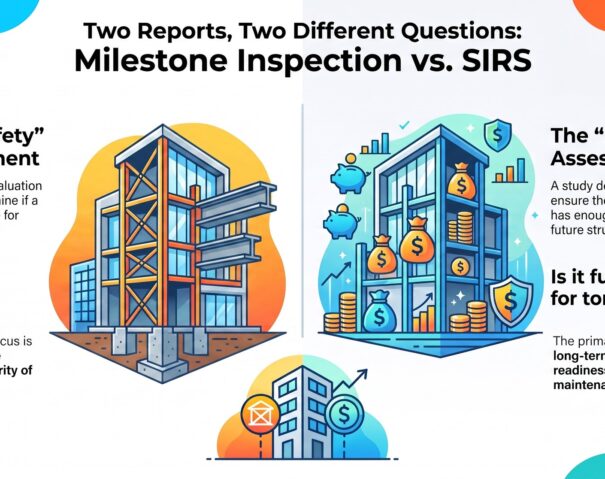
Two Reports, Two Very Different Numbers: Why Your SIRS and Milestone Inspection Don’t Match