The Report Is In. Here’s What Your Board Is Legally Supposed to Do With It.

Author: Greg Batista, PE, CGC, SI, President of G. Batista Engineering & Construction
Last Updated: November 2026
Here is what the SIRS report Florida law requires boards to handle. When a Florida condominium association receives its completed Structural Integrity Reserve Study (SIRS), the board’s core legal tasks are to give every unit owner a copy or a notice within 45 days, report the study’s completion to the state Division of Condominiums within the same 45 days, and carry the study’s reserve schedule into its budget work. This article gives first-time directors in South Florida a plain, step-by-step sequence, from the week the report lands to the next budget meeting. It also explains what the report does not decide for the board, which is why the preparer, the manager and the association’s attorney all stay involved. G. Batista Engineering & Construction wrote it to give new board members a calm, clear place to start.
Download the Post-SIRS Board Checklist (PDF)
What Is a Florida Condo Board Legally Supposed to Do After the SIRS Arrives?
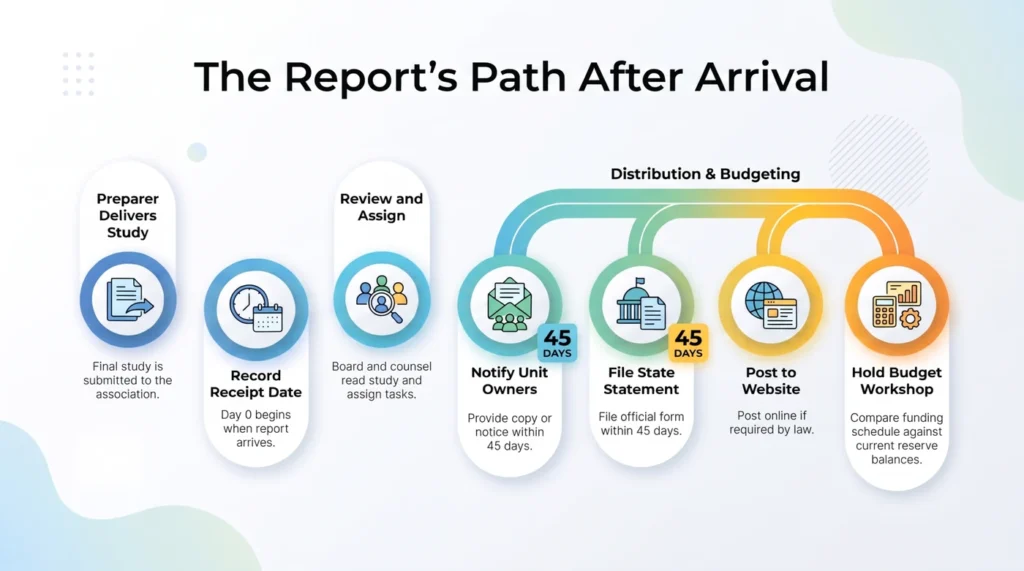
After the SIRS arrives, the board must send owners a copy or a notice within 45 days, file a statement with the Division of Condominiums within 45 days, and make sure the report’s reserve schedule reaches the budget. Nothing in that list requires technical training, but every item has a clock or a place to be recorded. The sections below walk through them in the order a new director will meet them.
What Happens in the First Week After the Report Lands?
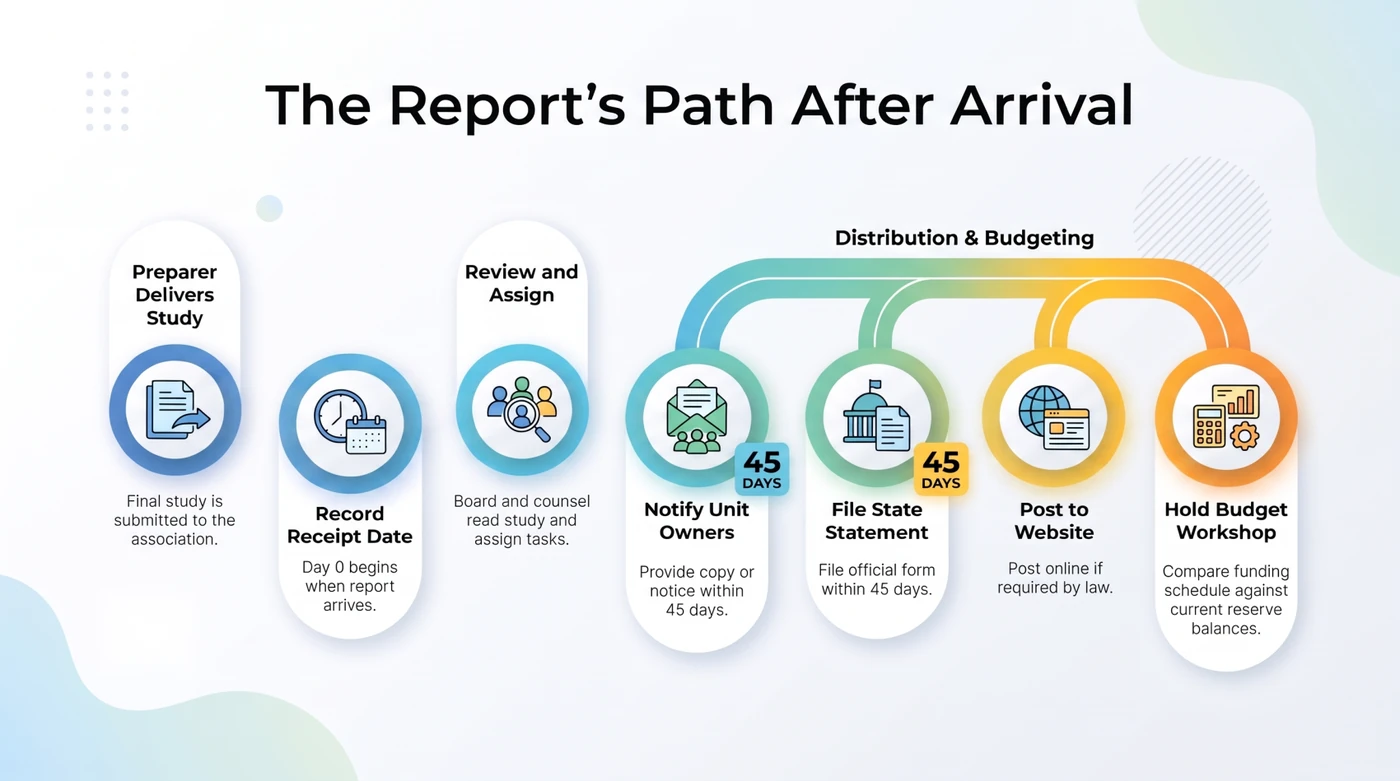
In the first week, the board’s job is to confirm when the report was received, read its key pages, and turn the legal tasks into a dated checklist. The 45-day periods in the statute run from the date the association receives the study, so that date is the first thing to write down. These are the steps I recommend new directors take, in order:
- Record the receipt date. Write down the day the final study reached the association, who received it and how. Every deadline below is counted from that date.
- Read the summary and the funding schedule first. The study lists each inspected item, its estimated remaining useful life, its estimated replacement cost or deferred maintenance expense, and a recommended annual reserve amount. Those pages tell the board what it is working with.
- Send the full report to every director. A report that only one person has read cannot be acted on by a board. Make sure every director has the same final version.
- Loop in the manager and the association’s attorney. The manager can run the notices and filings, and the attorney can confirm wording and timing for your governing documents. Also decide who will sign the officer or director affidavit acknowledging receipt of the completed study.
- Open one file for everything. Keep the report, the receipt date, the owner notice, the Division filing confirmation and the website posting record together, so the next board can find them.
None of this commits the association to a spending decision. It simply protects the board’s time, which is the scarcest resource in the first few weeks.
What Must the Association Send to Owners and the State Within 45 Days?
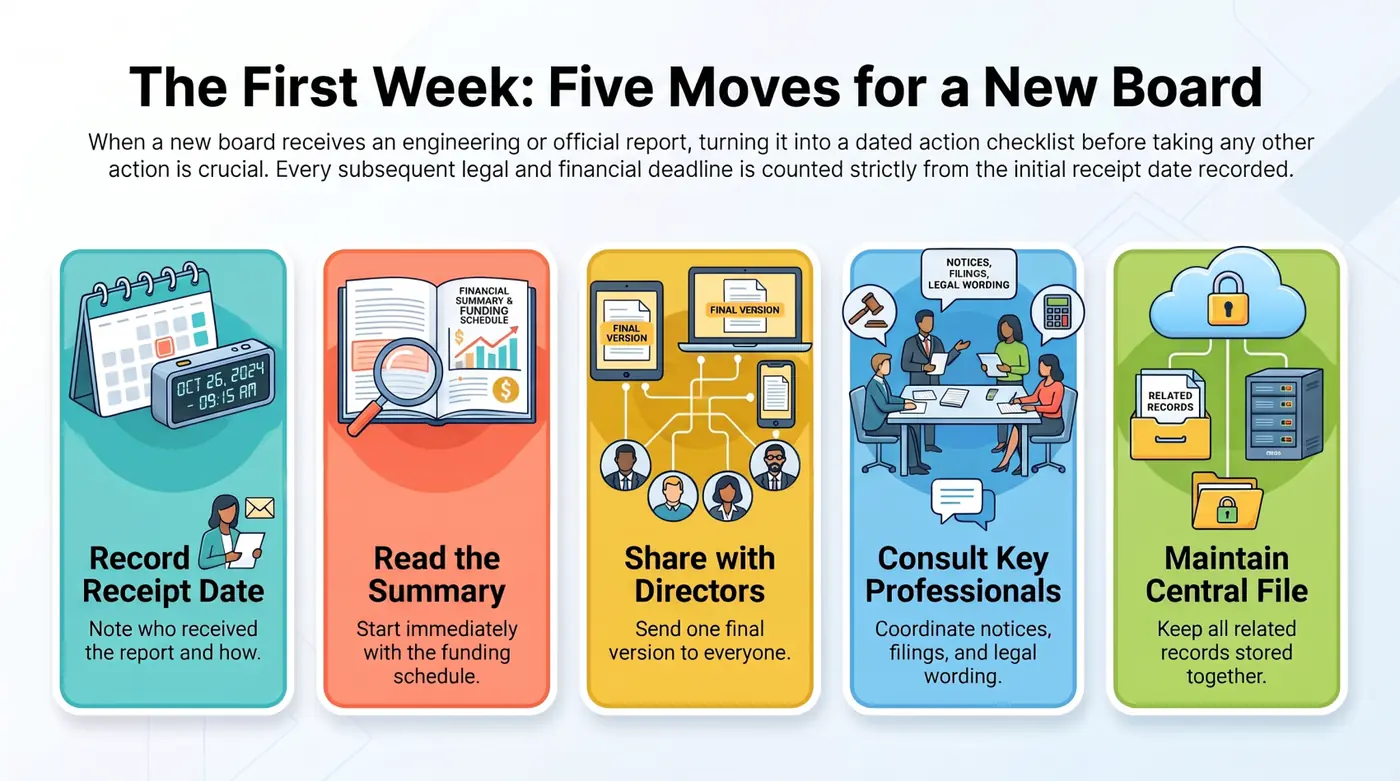
Within 45 days after receiving the SIRS, the association must give each unit owner a copy of the study or a notice that the completed study is available for inspection and copying on written request, and must give the Division of Condominiums a statement that the study was completed and made available to owners. Florida Statute 718.112(2)(g)11 and (g)12 set those two requirements. The copy or notice must go by United States mail or personal delivery to the owner’s address on file, or by electronic transmission to owners who previously consented to receive notices that way. The Division provides a form on its website for the statement, so the filing is a short, structured task rather than a drafting exercise.
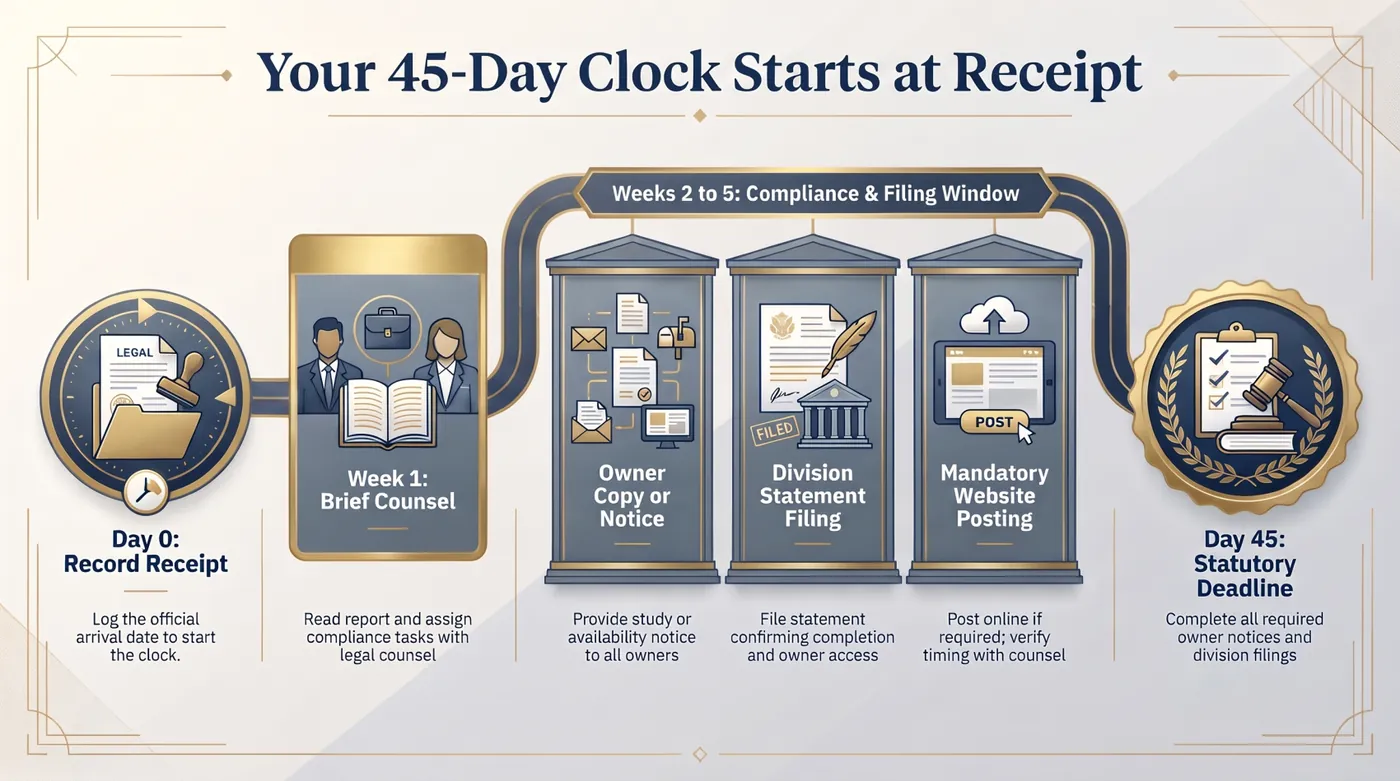
A third item sits beside those two. Section 718.111(12)(g) requires an association managing a condominium with 25 or more units, not counting timeshare units, to post digital copies of listed documents on its website or a mobile app, and the most recent structural integrity reserve study is on that list. Unless a shorter period applies, a document must be posted within 30 days after the association receives it. Associations with fewer than 25 units should confirm with their attorney how the requirement applies to them.
The statute adds one more step: an officer or director must sign an affidavit acknowledging receipt of the completed study (718.112(2)(g)10). Decide early who will sign it and keep it with the report.
| Task | What it means | Clock | Where to confirm |
|---|---|---|---|
| Owner copy or notice | Send each owner the study, or a notice that it is available to inspect and copy on written request | Within 45 days of receiving the study | Fla. Stat. 718.112(2)(g)11 |
| Division statement | Tell the Division the study was completed and made available to owners, using its online form | Within 45 days of receiving the study | Fla. Stat. 718.112(2)(g)12 and the Division’s form |
| Website posting | Post the most recent study if the condominium has 25 or more units | Within 30 days of receipt, unless a shorter period applies | Fla. Stat. 718.111(12)(g) |
| Officer or director affidavit | An officer or director signs an affidavit acknowledging receipt of the completed study | Confirm timing with counsel | Fla. Stat. 718.112(2)(g)10 |
| Official records | Keep the report and proof of each step in one file | Study kept at least 15 years | Fla. Stat. 718.111(12)(a)11.d |
Illustrative checklist for planning. Confirm exact requirements for your association with its attorney.
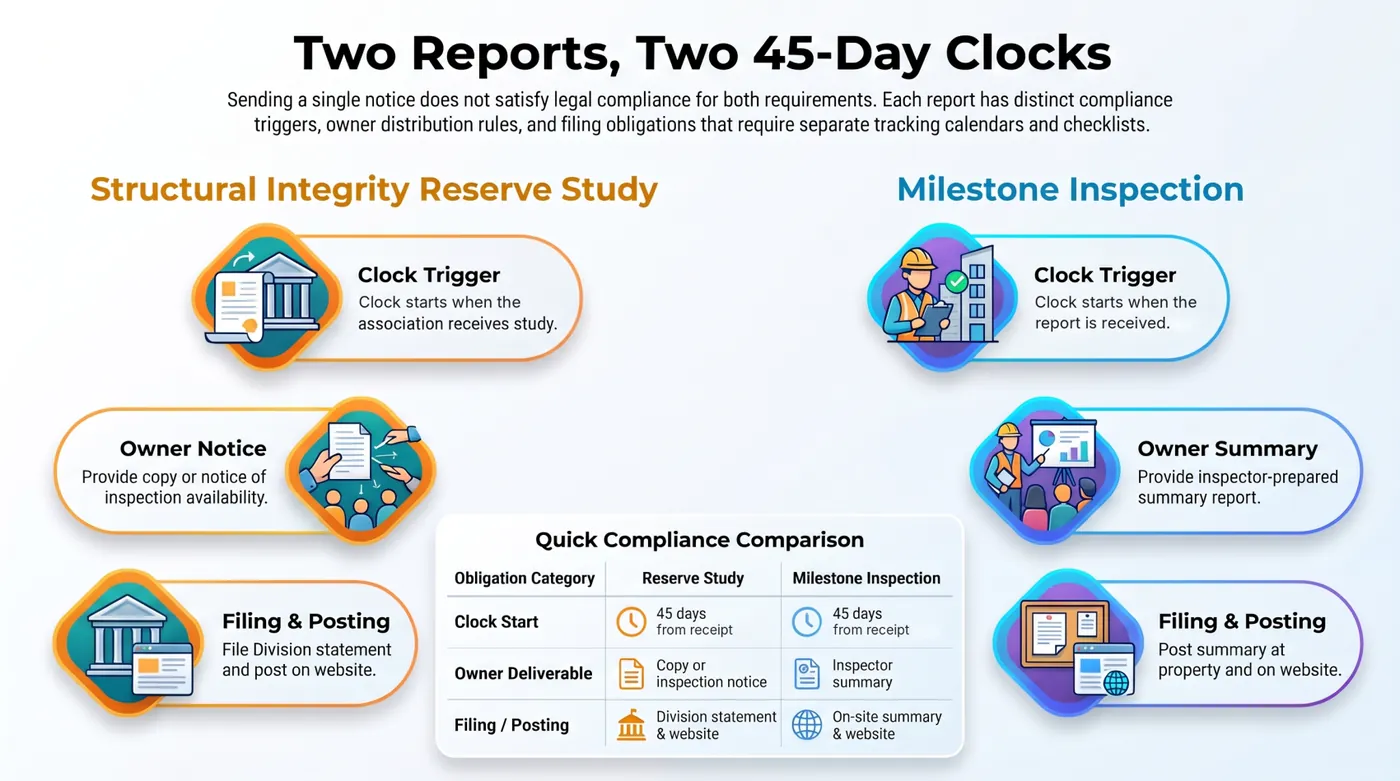
One caution for boards that also hold a milestone inspection report: the milestone inspection has its own 45-day duties under Florida Statute 718.112(2)(h), including distributing the inspector’s summary and posting it, counted from receipt of the inspection report. Sending the SIRS notice does not satisfy those, and the reverse is also true.
| Report | The 45 days run from | What owners receive | What is posted or filed |
|---|---|---|---|
| Structural Integrity Reserve Study (SIRS) | Receipt of the completed study | A copy of the study, or a notice that it is available to inspect and copy on written request | A statement to the Division of Condominiums; the study on the website if the condominium has 25 or more units |
| Milestone inspection | Receipt of the phase one or phase two report from the architect or engineer | The inspector-prepared summary, whatever the findings | The summary posted conspicuously on the property; the full report and summary on the website if one is required |
A notice or posting for one report does not satisfy the duties for the other. Confirm current requirements with the association’s attorney.
What Should the Board Do With the Reserve Funding Schedule?
The board should treat the reserve funding schedule as the starting point for its next budget, then compare it with current reserve balances and ask the preparer any questions before the budget is drafted. The study must include a recommended annual reserve amount for each inspected item, based on a baseline funding plan, so it gives the board a concrete schedule to work from.
- Compare the schedule with today’s reserves. Ask the manager for current reserve balances for each SIRS item and set them next to the study’s recommendations.
- Put the schedule on a budget meeting agenda. Decisions about how reserves are funded belong in the normal budget process. Owners must receive notice of a budget meeting, with a copy of the proposed budget, at least 14 days before it, and notice of any meeting that will consider assessments must say so and give the estimated cost and purpose (718.112(2)(c) and (e)).
- Ask the preparer to explain, not defend. A short walk-through of assumptions often answers most questions before they become disagreements.
- Bring in counsel on funding methods. Reserves for the SIRS items may be funded by regular assessments, special assessments, lines of credit or loans, and a special assessment, line of credit or loan needs approval by a majority of the association’s total voting interests. For budgets adopted on or after December 31, 2024, a unit-owner-controlled association may not waive or reduce reserves for those items, and it must obtain an updated study before adopting a budget whose funding does not align with the study’s plan (718.112(2)(f)2 and (g)4.c).
For the full picture of what a completed SIRS means for your board’s decisions, see our guide to the SIRS report and the decisions your board must make
Which Questions Belong With the Preparer, the Attorney, and the Manager?
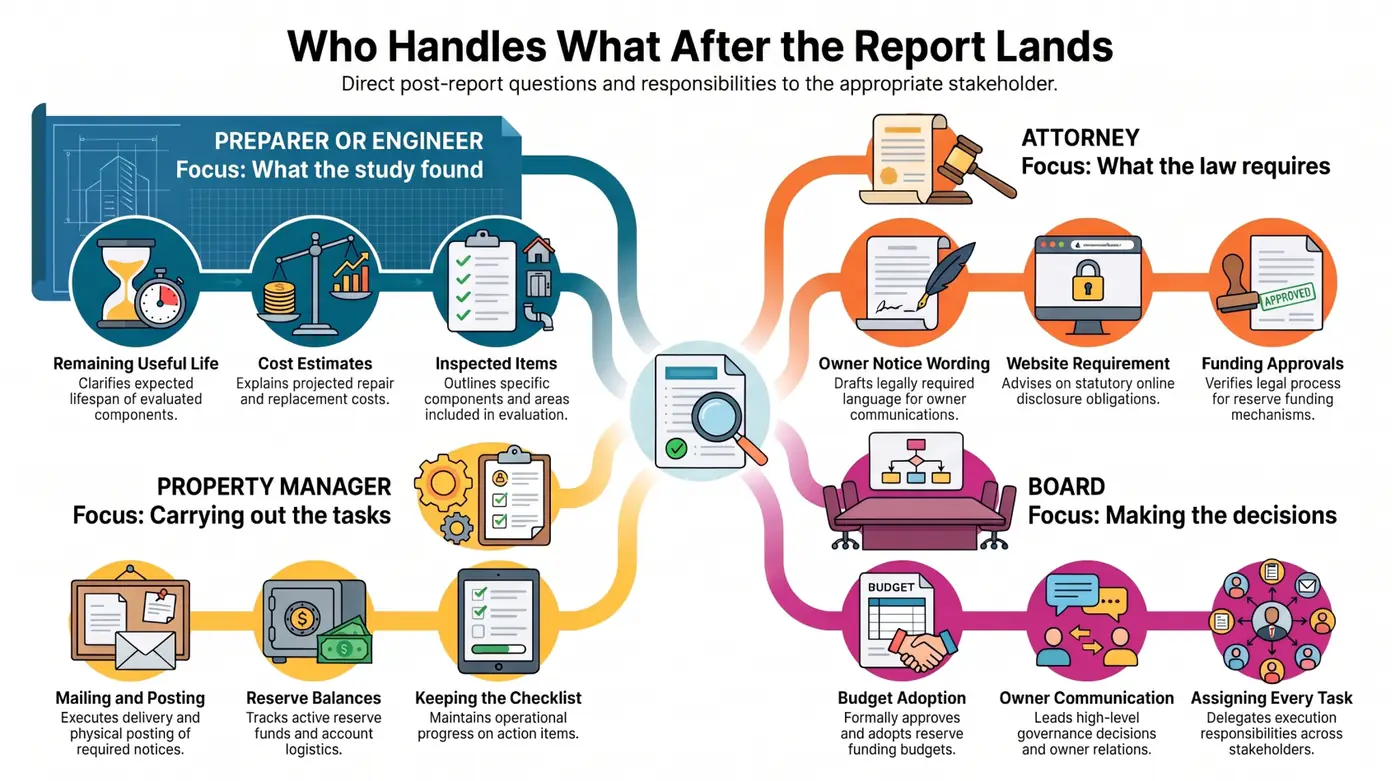
Questions about what the structural integrity reserve study found belong with the preparer, questions about what the law requires belong with the attorney, and questions about carrying out the tasks belong with the manager. Sending each question to the right person saves weeks of back and forth.
- The preparer or engineer: What a component’s remaining useful life means, how a cost estimate was built, and what was and was not visually inspected.
- The association’s attorney: How to word the owner notice, whether the website requirement applies, and which approvals a funding method needs.
- The property manager: Mailing the notice, posting documents, collecting reserve balances and keeping the checklist current.
- The board: Deciding what to adopt in the budget and how to communicate with owners. These decisions stay with the directors.
Why Does Handling the Report Correctly Matter for a New Board?
Handling the report correctly matters because a SIRS only helps a building when someone owns each task that follows it. As a licensed Professional Engineer (PE), Certified General Contractor (CGC), and Special Inspector (SI), I review how remaining useful life and replacement cost estimates are built, and I can tell you that a funding schedule is most useful when the board reads it beside its actual reserve balances rather than on its own.
- Compliance: The 45-day owner notice and the Division statement have clear clocks, and a dated checklist makes them routine.
- Owner trust: Owners respond better to a board that tells them the report is available, where to find it and what happens next.
- Continuity: Boards change. A single file with the receipt date, notices and filings lets the next group of directors pick up where the last one stopped.
- Planning: A study that is read early gives the board more room to schedule budget meetings, ask questions and sequence any work.
What Does the First Week With a SIRS Report Look Like in a Real South Florida Building?
The boards that handle a SIRS best are the ones that turn it into a dated checklist during the first week. What follows is how that week went at a residential condominium in South Florida that my firm worked with, with details changed to protect the association’s privacy.
My engineering firm received a call from the Board Secretary of a residential condominium in South Florida, a first-time director who had been elected only a few months earlier. The preparer had delivered the final SIRS the previous Tuesday, and the Secretary had a thick report, a manager who assumed the board had it, and a board that assumed the manager had it. Nobody had written down the date it arrived.
When we met with the board, the first thing we did was set the clock. The Property Manager found the delivery email, the Board President confirmed who had opened it, and the Secretary wrote the receipt date at the top of a one-page checklist. From that date we counted forward 45 days and marked two deadlines, one for the owner notice and one for the statement to the Division of Condominiums.
Then we walked through the report together, starting with the summary and the funding schedule rather than the component pages. I explained what remaining useful life means, why replacement costs are estimates rather than quotes, and which items the preparer had verified visually. The Board Treasurer asked whether the schedule changed anything for the coming budget, and we agreed that question would go on the agenda for a budget workshop once the manager had current reserve balances.
Over the next two weeks the board sent owners a notice that the completed study was available for inspection and copying, the Property Manager filed the Division’s online form and posted the report to the association’s website after confirming the requirement with the association’s attorney. The first question from an owner after the notice went out was whether the report meant a special assessment was coming. The board’s answer, which I helped them word, was that the report was a planning document, that no funding decision had been made, and that the budget workshop would be noticed to every owner. That answer settled the room, and it set the tone for how the board talked about the report from then on.
The Secretary later told me the report felt much less intimidating once it had a to-do list attached to it. The Board President added that the best decision the board made that month was deciding who owned each task.
What Do New Condo Board Members Usually Ask After a SIRS Arrives?
Do we have to send every owner the full report?
Not necessarily. Within 45 days of receiving the study, the association must either give each owner a copy or deliver a notice that the completed study is available for inspection and copying on written request. Which option fits your building depends on your documents, your owners and your attorney’s advice. Whichever you choose, keep proof of when and how the notice went out.
When does the 45-day clock start?
The statute counts from the day the association receives the structural integrity reserve study. That is why the first step in this article is to write the receipt date down and who received it. If the date is unclear, ask your attorney how to document it and treat the earliest reasonable date as the safer planning assumption.
Does the board have to vote to accept the report?
The SIRS provisions in Florida Statute 718.112(2)(g) do not describe a separate vote to accept the report. Budget adoption and funding decisions that follow from it do go through the board’s normal process, and a special assessment, line of credit or loan to fund the SIRS items requires approval by a majority of the total voting interests. Your attorney can confirm which votes apply to your association.
What if the board has questions about what the report found?
Start by asking the preparer to walk the board through the findings and assumptions. A SIRS, including its visual inspection portion, must be performed or verified by an engineer licensed under Chapter 471, an architect licensed under Chapter 481, or a reserve specialist or professional reserve analyst certified by the Community Associations Institute or the Association of Professional Reserve Analysts, so the preparer is the right person to explain it. If the board believes something is missing, the attorney can advise on next steps.
Where does the report go once the notices are done?
Keep it in the association’s official records along with the receipt date, the owner notice, the Division confirmation and any website posting record. The statute requires structural integrity reserve studies to be kept for at least 15 years after completion (718.111(12)(a)11.d). A single, well-labeled file makes the next study, and the next board, much easier.
What Do These Terms Actually Mean?
These four terms appear in almost every conversation about the report, and each has a plain meaning.
- Structural Integrity Reserve Study (SIRS): A required study of a condominium building’s major structural and safety-related components, completed at least every 10 years for each building three habitable stories or higher. It estimates each component’s remaining useful life and replacement cost and recommends reserve funding.
- Reserve funding schedule: The part of the study that recommends annual reserve amounts for each inspected item. It is based on a baseline funding plan.
- Division statement: The short filing the association submits to the Division of Florida Condominiums, Timeshares and Mobile Homes confirming that the study was completed and made available to owners.
- Notice of availability: A written notice telling owners the completed study can be inspected and copied on written request, used instead of mailing every owner a full copy.
How Does Florida Law Define the Board’s Duties After a SIRS?
Florida law gives the board a short list of defined duties after a SIRS arrives, mainly in Florida Statute 718.112(2)(g) and 718.111(12)(g). Recent legislation, including CS/CS/HB 913 (2025), has adjusted parts of these sections, so your attorney should confirm the current text. The main points are:
- Study requirement: A SIRS is required at least every 10 years after the condominium’s creation for each building three habitable stories or higher.
- Who prepares it: The study, including its visual inspection portion, must be performed or verified by a licensed engineer, a licensed architect, or a reserve specialist or professional reserve analyst certified by the Community Associations Institute or the Association of Professional Reserve Analysts.
- Owner copy or notice: Within 45 days of receiving the study (718.112(2)(g)11).
- Division statement: Within 45 days of receiving the study, using the Division’s online form (718.112(2)(g)12).
- Website posting: Associations managing 25 or more units, not counting timeshare units, must post the most recent study on the association’s website or app, within 30 days unless a shorter period applies (718.111(12)(g)).
- Officer or director affidavit: An officer or director must sign an affidavit acknowledging receipt of the completed study (718.112(2)(g)10).
- Records retention: The study must be kept in the official records for at least 15 years after it is completed (718.111(12)(a)11.d).
- Milestone inspection duties are separate: Florida Statute 718.112(2)(h) and 553.899 set their own post-report duties for milestone inspections, so a SIRS filing does not satisfy them.
- Deadline tracks: The general SIRS deadline of December 31, 2025 has already passed for associations that did not coordinate their study. Associations coordinating the SIRS with a milestone inspection may use December 31, 2026. Confirm which track applies to you.
What Do Skeptical Board Members Usually Get Wrong About Post-SIRS Duties?
“The manager or the engineer handles all of this.”
The duties belong to the association, and the board is responsible for making sure they happen. The manager and the preparer are valuable partners, but neither can decide for the board. The simplest fix is a named owner and a due date for every item on the checklist.
“If owners do not ask for the report, we have nothing to do.”
The notice itself must go out within 45 days whether or not any owner asks. The written request only comes into play if the association chose the notice-of-availability route and an owner then wants a copy. Skipping the notice because nobody has asked defeats the purpose of the requirement.
“Once we file and notify owners, we are finished.”
Those steps are the starting line, not the finish. The report’s funding schedule still has to be reviewed, discussed and reflected in the budget process, and the study must be refreshed on its required cycle. Treat the filings as the end of the first chapter and the budget meeting as the beginning of the next.
Bullet Summary
- Write down the date the association received the final SIRS. Every deadline starts there.
- Within 45 days, give owners a copy or a notice of availability.
- Within the same 45 days, file the Division of Condominiums statement using its online form.
- Post the study on the website within 30 days if the condominium has 25 or more units.
- Have an officer or director sign the affidavit acknowledging receipt of the study.
- A milestone inspection has separate 45-day duties, so a SIRS filing does not cover it.
- Read the funding schedule next to current reserve balances and take it to a budget meeting.
- Send questions to the right person: preparer, attorney or manager.
Why Does a Clear Post-Report Routine Matter for Florida Buildings?
A clear routine matters because it turns a dense report into a short list of tasks that any board can finish. Owners get timely information, the state gets its filing, and the board has a record that shows it moved promptly. This article covered the first steps, and the pillar article, Your SIRS Report Just Arrived, covers the larger decisions that follow. G. Batista Engineering & Construction is glad to answer questions at any point.
References / Bibliography
- Florida Legislature, “Florida Statutes, Section 718.112, Bylaws,” 2025. [Online]. Available: https://www.flsenate.gov/Laws/Statutes/2025/718.112
- Florida Legislature, “Florida Statutes, Section 718.111, The association,” 2025. [Online]. Available: https://www.flsenate.gov/Laws/Statutes/2025/718.111
- Florida Legislature, “Florida Statutes, Section 553.899, Mandatory structural inspections for condominium and cooperative buildings,” 2025. [Online]. Available: https://www.flsenate.gov/Laws/Statutes/2025/553.899
- Florida Legislature, “CS/CS/HB 913 (2025), Condominium and Cooperative Associations, Ch. 2025-175, Laws of Florida.” [Online]. Available: https://www.flsenate.gov/Session/Bill/2025/913
- Florida Legislature, “CS/CS/CS for SB 1178 (2024), Condominium and Cooperative Associations.” [Online]. Available: https://flsenate.gov/Session/Bill/2024/1178
- Florida Legislature, “CS/SB 154 (2023), Condominium and Cooperative Associations, Ch. 2023-203, Laws of Florida.” [Online]. Available: https://laws.flrules.org/2023/203
- Florida Legislature, “SB 4-D (2022), Condominium and Cooperative Associations, Ch. 2022-269, Laws of Florida.” [Online]. Available: https://www.flsenate.gov/Session/Bill/2022D/4D
- Florida Department of Business and Professional Regulation, Division of Florida Condominiums, Timeshares and Mobile Homes, “Condominiums, Timeshares and Mobile Homes.” [Online]. Available: https://www2.myfloridalicense.com/condominiums-timeshares-and-mobile-homes/
- Henderson Franklin, “Understanding Structural Integrity Reserve Study, Milestone Inspection Reports, Deadlines and Board Responsibilities.” [Online]. Available: https://www.henlaw.com/news-insights/understanding-structural-integrity-reserve-study-milestone-inspection-reports-deadlines-and-board-responsibilities/
- Berger Singerman, “Crucial Deadlines Are Approaching Relating to the Structural Integrity Reserve Study Required for Condominiums,” Dec. 3, 2024. [Online]. Available: https://bergersingerman.com/news-insights/crucial-deadlines-are-approaching-relating-to-the-structural-integrity-reserve-study-required-for-condominiums
Need Help With Your SIRS? Get a Quote in 24 Hours


 Structural Inspections
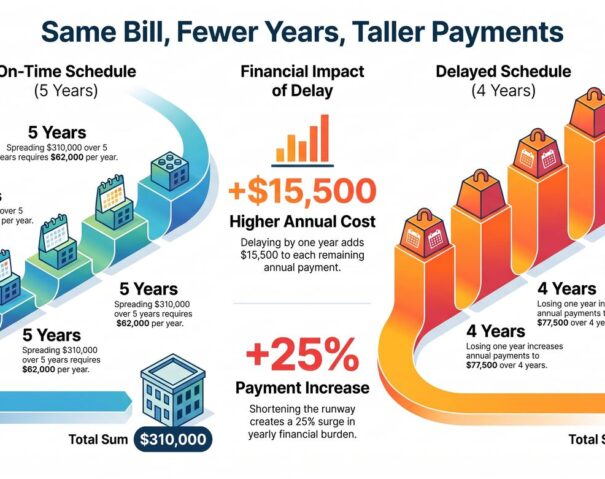
What One Year of Delay Actually Added to This Association’s Reserve Bill
 Structural Inspections
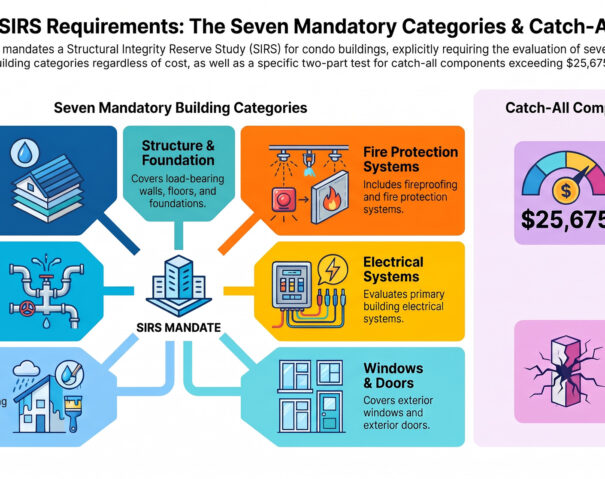
The $25,675 Rule Most Boards Get Wrong, Even When They Think They’re Covered
 Structural Inspections
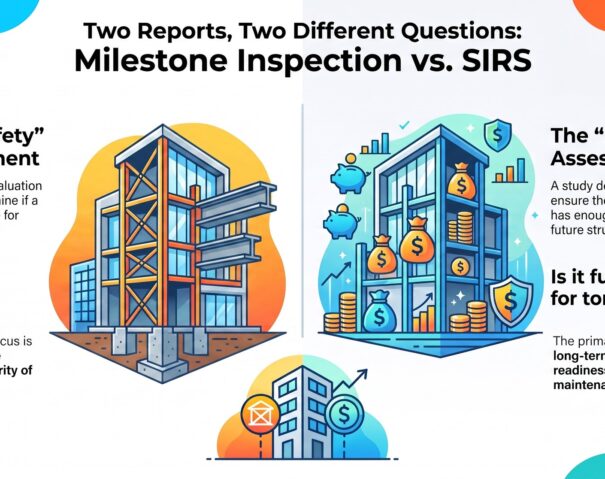
Two Reports, Two Very Different Numbers: Why Your SIRS and Milestone Inspection Don’t Match