Two Reports, Two Very Different Numbers: Why Your SIRS and Milestone Inspection Don’t Match

Author: Greg Batista, PE, CGC, SI, President of G. Batista Engineering & Construction
Last Updated: October 2026
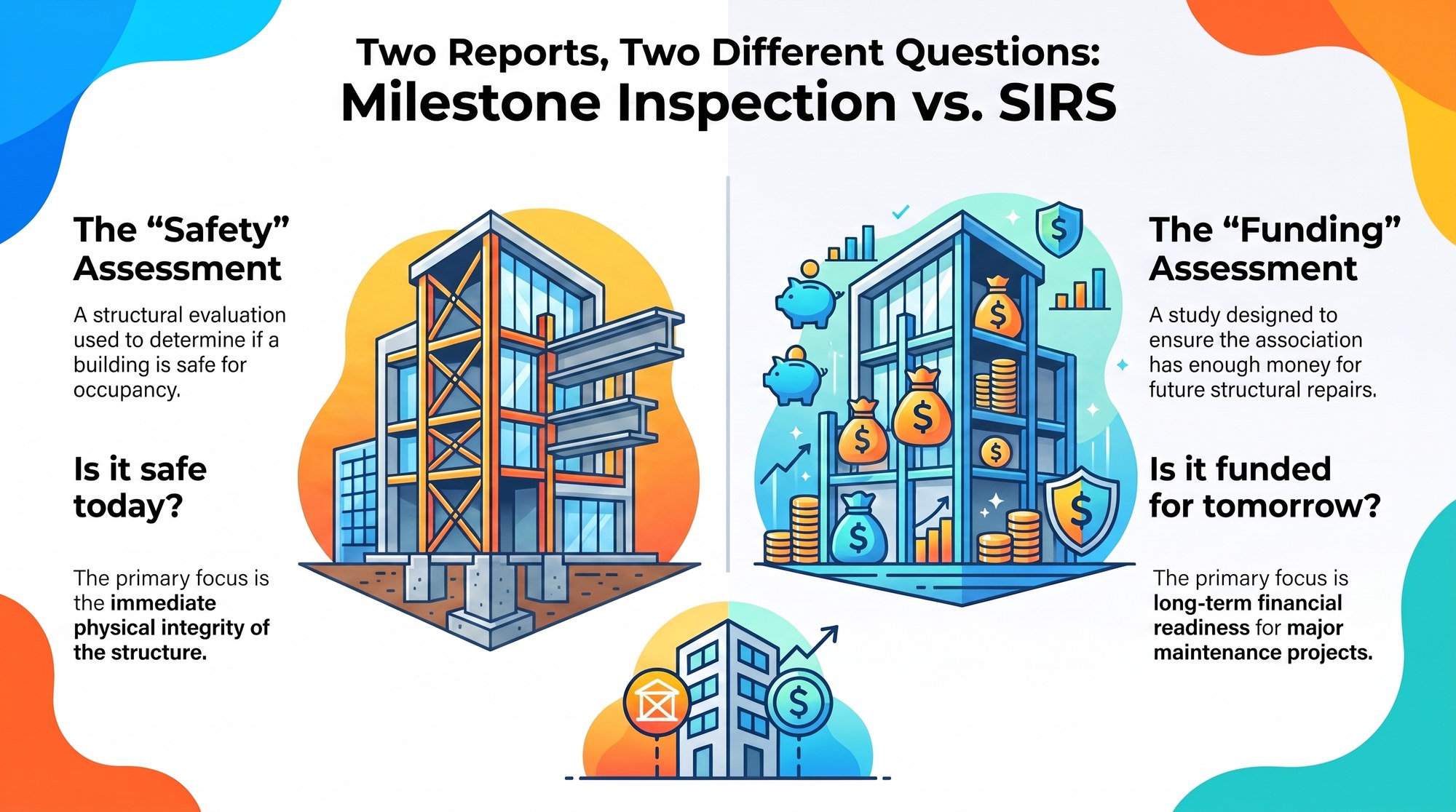
Your Structural Integrity Reserve Study (SIRS) and your milestone inspection can land on your board’s desk with two very different bottom lines, and both reports can be correct at the same time. That happens because a SIRS and a milestone inspection are built to answer two separate questions: whether your building’s structure is sound today, and how much money your association needs to set aside for the future. This article walks your South Florida board through why the numbers diverge, what each report is actually built to measure, and how to talk about the difference with owners without triggering panic or confusion.
For the full picture of what a completed SIRS means for your board’s legal and financial obligations, see the companion pillar article, Your SIRS Report Just Arrived. Here’s Everything Your Board Needs to Decide, Defend, and Fund.
Download the SIRS vs. Milestone Inspection Guide (PDF)
Why Don’t My SIRS and Milestone Inspection Numbers Match?
They don’t match because the two reports answer different questions. The table below shows the difference at a glance.
| Milestone Inspection | SIRS | |
|---|---|---|
| Governing Statute | § 553.899 | § 718.112(2)(g) |
| Core Question | Is the building’s structure sound today? | Is the association funded for tomorrow? |
| Who Prepares It | Licensed engineer or architect | Licensed engineer or architect, or a CAI-certified reserve specialist or professional reserve analyst |
| Outcome Type | Sealed report on structural condition, with any recommended repairs | Component-by-component reserve funding plan |
| Scope | Whole-building structural soundness | 8 required categories only |
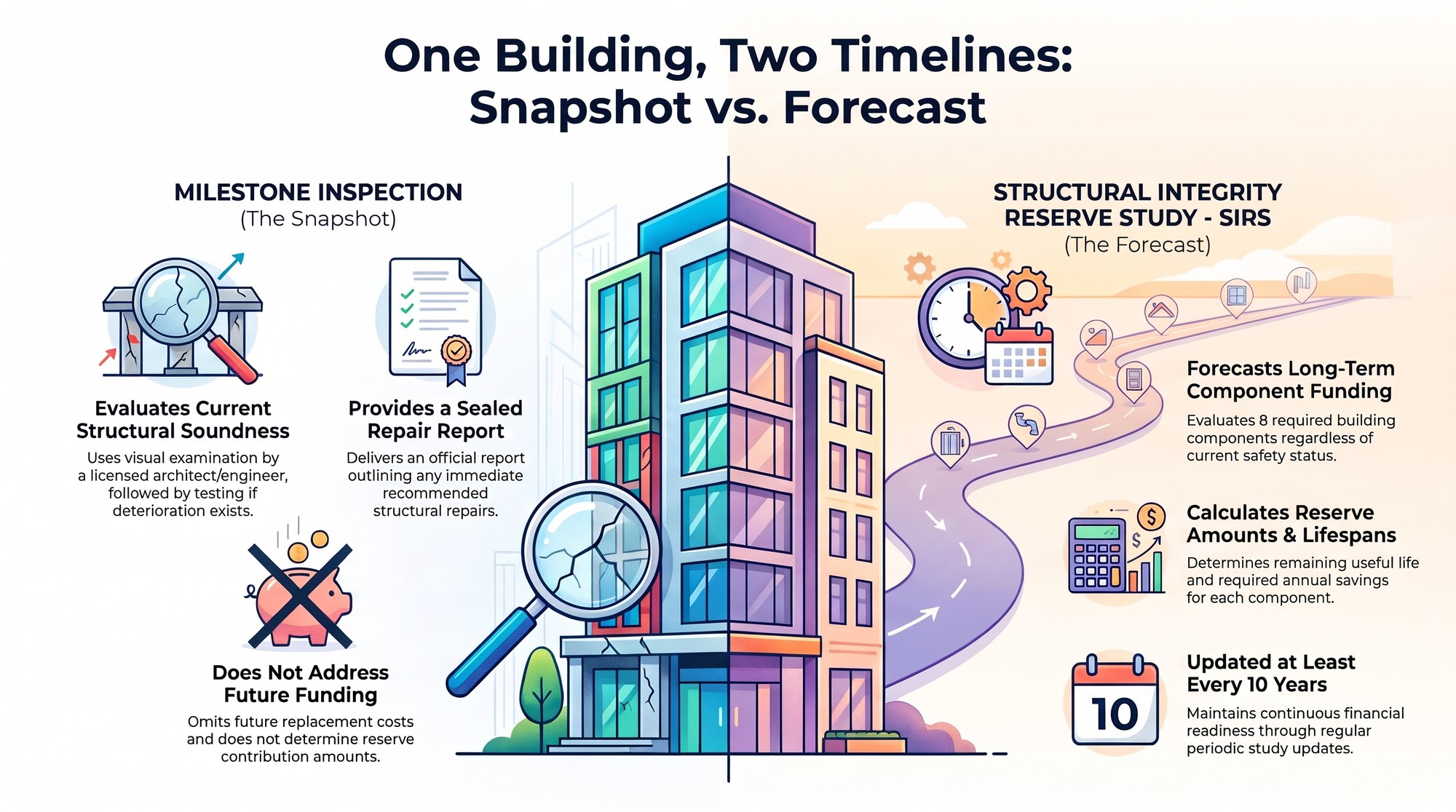
What Does a Milestone Inspection Actually Measure?
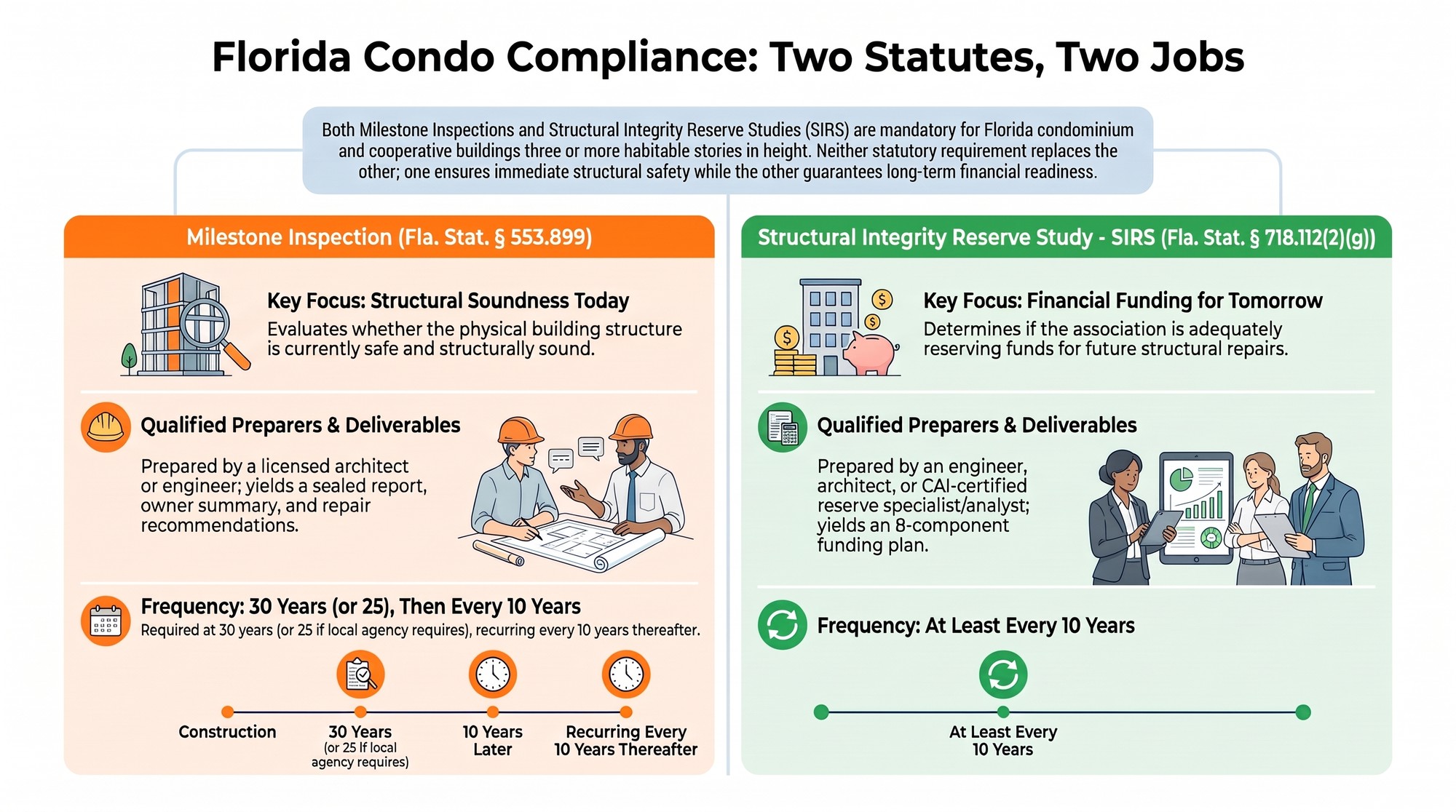
A milestone inspection answers one narrow question: is the building’s structure currently sound. Required under Florida Statute 553.899 for condominium and cooperative buildings three or more habitable stories in height, it begins with a visual examination (Phase One) by a licensed engineer or architect. The first inspection is due by December 31 of the year the building reaches 30 years of age, or 25 years where the local enforcement agency requires it, and every 10 years after that. Three or more habitable stories decides whether the law applies, but the schedule itself runs on the building’s age.
The inspector is looking for substantial structural deterioration, meaning conditions that affect the building’s structural integrity right now, not conditions that might require funding five or ten years down the road. If Phase One finds none, the inspection stops there and the sealed report says so. If it does find substantial deterioration, a Phase Two inspection with testing follows, and the report must identify recommended repairs. A Phase Two requirement is not the same as an unsafe finding.
Either way, a milestone inspection report does not attempt to price out every building system’s remaining useful life or tell the board how much to reserve for a roof replacement in 2031. It is a safety checkpoint, not a funding plan.
What Does a SIRS Actually Measure?
A Structural Integrity Reserve Study answers a completely different question: how much money does the association need to set aside, and on what schedule, to fund eight required structural and life-safety components over their remaining useful life. Required under Florida Statute 718.112(2)(g), the SIRS assigns a current condition, a remaining useful life estimate, and a funding requirement to each of the eight categories, whether or not any of them show a current safety problem.
As a licensed Special Inspector who has prepared and reviewed SIRS reports across Broward, Miami-Dade, and Palm Beach counties since the post-Surfside requirements took effect, I’ve seen this exact funding gap concentrate in one component far more often than it spreads evenly across all eight.
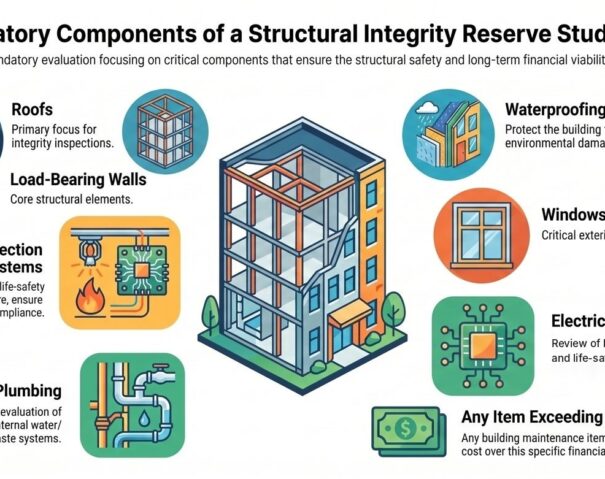
The eight categories are the roof; the structure, including load-bearing walls and other primary structural members; fireproofing and fire protection systems; plumbing; electrical systems; waterproofing and exterior painting; windows and exterior doors; and any other item whose replacement or deferred maintenance cost exceeds $25,000 (or the DBPR inflation-adjusted amount, whichever is greater) and whose failure would negatively affect the other seven.
A component can be in fine physical condition today and still carry a large SIRS funding number, simply because it is approaching the end of its expected service life on a normal replacement schedule. Roofing is the clearest example. A roof with six years of remaining useful life is not unsafe, but the SIRS still has to show the association saving toward its eventual replacement.
Why Can a SIRS Number Be Higher Than What the Milestone Inspection Ever Suggested?
They look at different timeframes. The milestone inspection is a snapshot of today’s structural condition. The SIRS is a multi-year funding forecast that has to account for every required component’s eventual replacement, even components that are performing exactly as expected right now.
They cover different scopes. A clean milestone inspection covers structural soundness across the whole building. The SIRS is limited to eight specific categories, but within those categories it has to fully fund replacement cost, not just flag a problem.
They are prepared under different statutes, by different professionals, on different timelines. A milestone inspection under Section 553.899 and a SIRS under Section 718.112(2)(g) are two separate statutory requirements. Florida law allows the two inspection cycles to coordinate on timing for some associations, but they remain legally distinct reports with distinct purposes.
Put simply: a clean milestone inspection tells owners that no substantial structural deterioration was found today. A large SIRS number tells owners the association has not yet finished saving for tomorrow. Neither number contradicts the other, but if a board doesn’t explain the difference clearly, owners often assume it does.
What Does This Look Like in a Real South Florida Building?
The Setup
A mid-rise association in Broward County completed its milestone inspection that spring with no findings of substantial structural deterioration. The engineer’s letter was one page, and the board president read it out loud at the meeting almost in passing, more relieved than surprised. Nobody expected a problem. The building was well-kept, the landscaping immaculate, the lobby recently repainted.
Two months later, the SIRS came back showing a reserve funding requirement of just over $2.1 million, nearly three times the $740,000 the association had budgeted in its existing reserve schedule, and the mood in the room shifted immediately.
The Confrontation
At the next meeting, an owner in the back row stood up before the property manager had even finished her opening remarks and asked the question everyone else was thinking: how can the building be safe and also need that much money. A few other owners murmured agreement. One asked, only half joking, whether the association had hired the wrong engineer the first time around. The property manager, to her credit, didn’t get defensive. She asked for two minutes to walk through the numbers before taking more questions.
The Walkthrough
She put the milestone inspection letter on the screen first, plain and unadorned, and reminded the room what it said: no substantial structural deterioration found. Then she pulled up the SIRS summary table and went component by component instead of leading with the total.
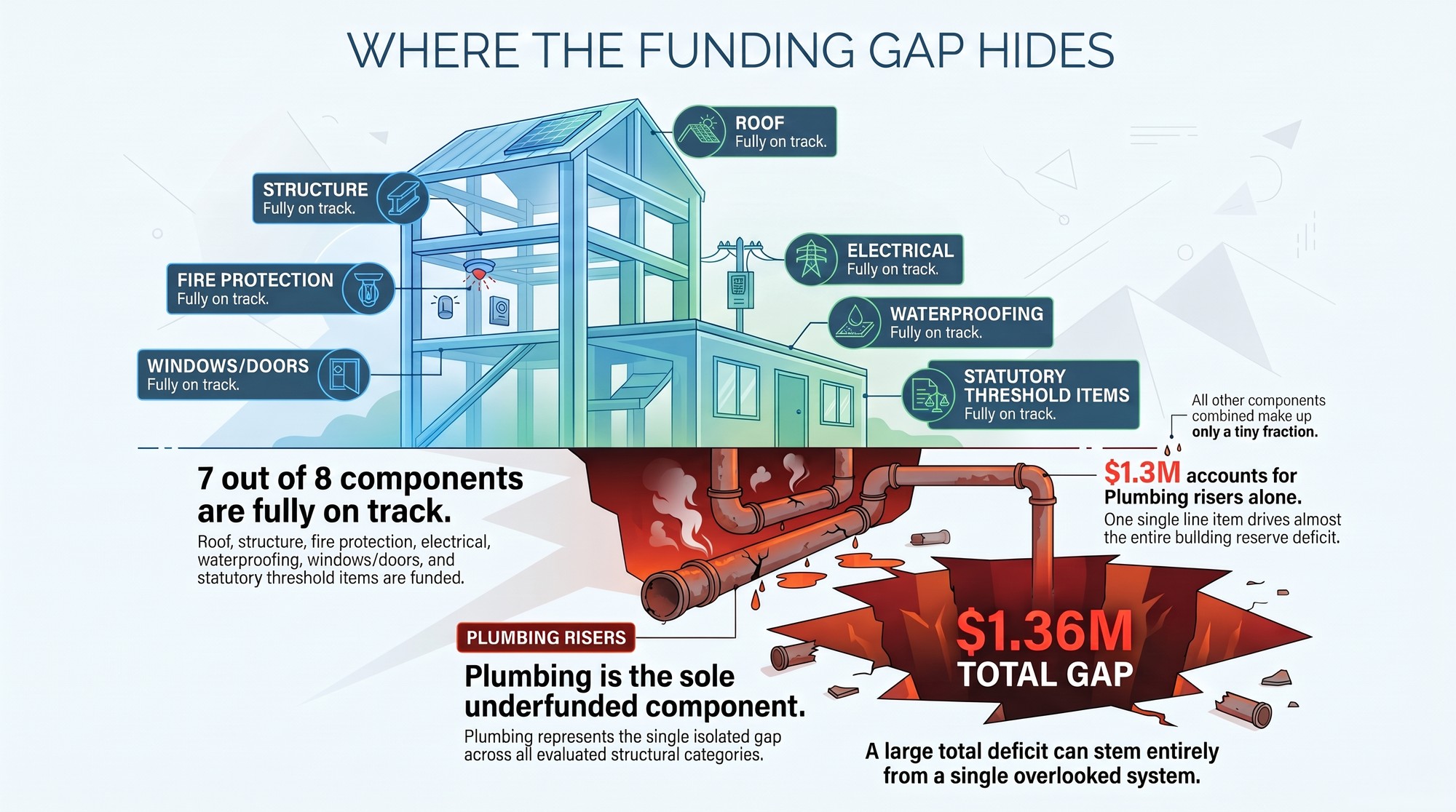
The building’s structural members, fireproofing, and electrical systems were all funded adequately and reflected the same clean picture as the milestone inspection. Roofing was on track. Windows and exterior doors were on track. Then she got to plumbing, and the room went quiet.
The Gap
The building’s original plumbing risers, installed when the building was constructed decades earlier, were approaching the end of their expected service life. They weren’t leaking. They weren’t failing. But a full-system replacement, priced at roughly $1.3 million when it eventually came due, would cost far more than the association had ever set aside for it, and that single line item accounted for nearly all of the $1.36 million gap between what the board expected and what the SIRS required.
The plumbing wasn’t a safety problem today. It was a funding problem the board hadn’t known it had until an engineer priced it out on paper.
The Reframe
One board member asked why the milestone inspection hadn’t caught this. The property manager explained, patiently, that it wasn’t built to. The milestone inspection would only have flagged the plumbing if it were currently failing or posing a structural risk. It wasn’t.
The SIRS existed precisely to catch this kind of gap years before a corroded riser becomes a five-alarm plumbing failure and an emergency assessment. Once she reframed it that way, the tone in the room changed from suspicion to something closer to relief that the problem had been caught early, on paper, instead of in a flooded hallway.
The Resolution
The board adopted a phased reserve increase targeted specifically at the plumbing line rather than an across-the-board special assessment, spread over three budget cycles to keep the impact on monthly dues predictable. At the following owner meeting, the property manager opened with the milestone inspection result stated plainly, in the first thirty seconds, before the SIRS number was ever mentioned. No one asked whether the building was unsafe that night. The questions were about the payment plan.
Structural Integrity Reserve Study Quote in 24 Hours
How Do the Two Reports Work Together Under Florida Law?
Are Both Reports Legally Required?
Both are legally required for qualifying buildings. Condominium and cooperative buildings three or more habitable stories in height generally must complete both a milestone inspection under Section 553.899 and a SIRS under Section 718.112(2)(g), on their own separate statutory schedules. Neither report substitutes for the other, and completing one does not satisfy the requirement for the other.
Who Can Prepare Each Report?
Different professionals can prepare each report. A milestone inspection must be performed by a licensed engineer or architect. A SIRS must be performed or verified by a licensed engineer or architect, or by a reserve specialist or professional reserve analyst certified by the Community Associations Institute. That sometimes means the two reports come from different firms, even for the same building. That’s normal, and it’s part of why the findings can read differently in tone even when they don’t conflict in substance.
How Do the Two Deadlines Line Up?
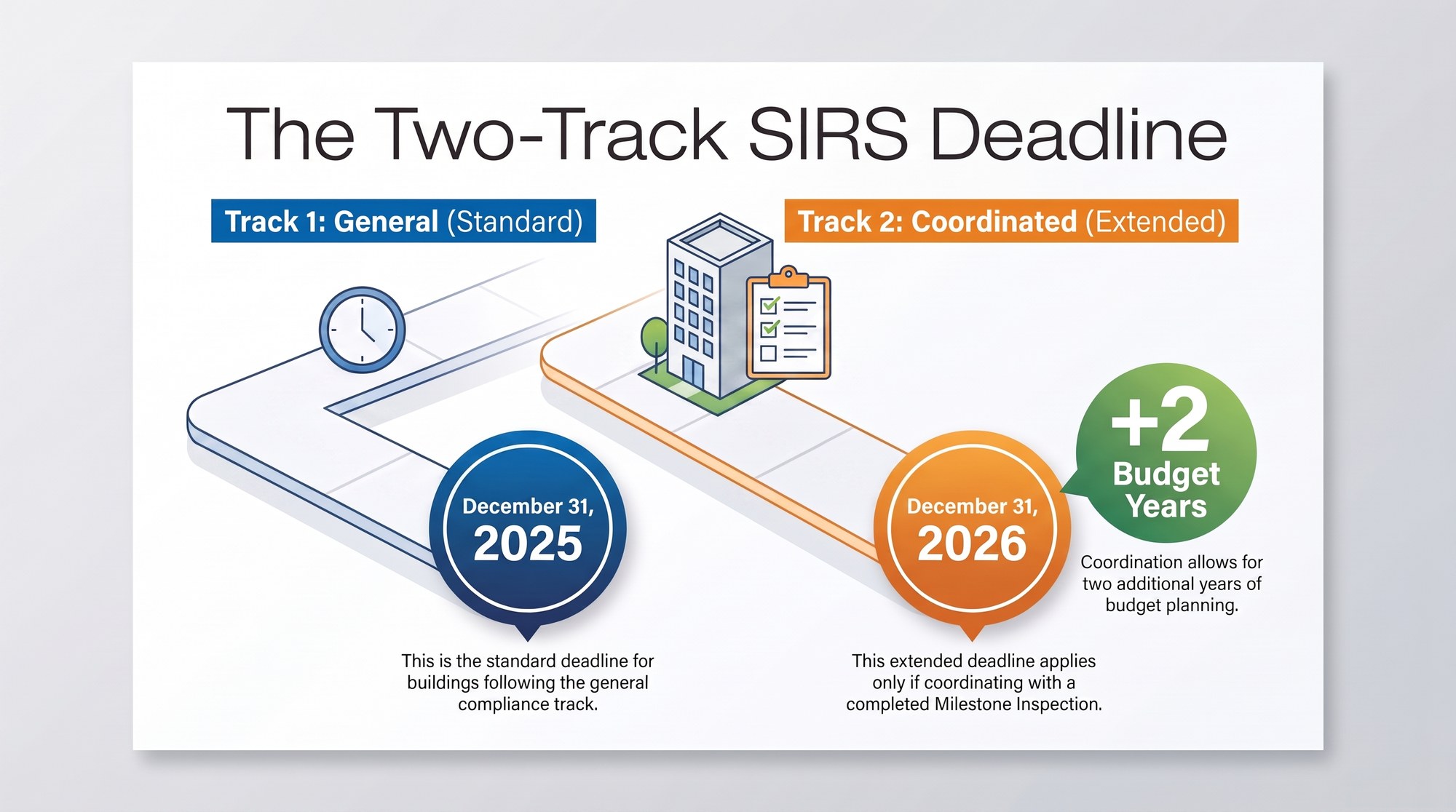
Timing can be coordinated, but the two deadlines are not identical. Florida’s SIRS deadline structure is two-track. For condominiums, the original statutory deadline for existing, non-developer-controlled associations to complete their first SIRS was extended by HB 913 to December 31, 2025. For cooperatives, the first-study deadline under Fla. Stat. 719.106 is December 31, 2024.
Associations that have recently completed a required milestone inspection under Section 553.899 may, under HB 913, delay commissioning their SIRS for up to two consecutive budget years following that inspection, and the statute sets December 31, 2026 as the latest date any SIRS may be completed. Boards in that position should confirm their specific timeline with their engineer rather than assuming either deadline applies by default.
Does One Report Override the Other?
Findings from one report do not override the other. A clean milestone inspection does not reduce or waive SIRS funding obligations, and a high SIRS number does not mean the milestone inspection result was wrong. They are answering different questions under different statutes, and both stand on their own.
What Happens After Each Report Is Delivered?
Owners will see both reports. The association must distribute the inspector’s milestone summary to every unit owner within 45 days of receiving it, regardless of the findings, and the SIRS becomes part of the association’s official records. Boards should expect owners, and in some cases regulators, to review both reports side by side. That makes it worth preparing the component-by-component explanation described above before the reports reach owners, rather than reacting to owner questions in real time at a packed annual meeting.
What Do Board Members Usually Get Wrong When the Numbers Don’t Match?
Assuming the higher number must be the more accurate one. Boards sometimes treat the SIRS total as a correction to the milestone inspection, when in fact the SIRS is simply measuring something the milestone inspection was never built to measure.
Leading with the total instead of the components. A large SIRS figure presented as one lump number tends to alarm owners. Presented component by component, the same figure is usually explainable, and often concentrated in one or two categories rather than spread evenly across all eight.
Assuming a clean milestone inspection means reserves can wait. A clean milestone inspection is good news about current structural condition. It says nothing about whether the association is adequately funding future replacement costs, which is the SIRS’s job.
Treating the two reports as competing instead of complementary. The most effective boards use the milestone inspection to reassure owners about structural condition and the SIRS to explain the funding plan, presented as two pieces of the same picture rather than a contradiction to be resolved.
What Do Boards Usually Ask When the Two Reports Don’t Match?
Does a High SIRS Number Mean Our Building Failed Inspection?
No. A SIRS funding requirement and a milestone inspection finding are unrelated outcomes. A building can come through its milestone inspection with no findings of substantial structural deterioration and still carry a large SIRS number, because the SIRS is pricing future replacement costs, not current structural conditions.
Can We Use a Clean Milestone Inspection to Reduce Our SIRS Reserve Requirement?
No. The two reports are prepared under separate statutes for separate purposes, and a milestone inspection result does not adjust the SIRS’s required funding levels for the eight covered components.
Which Report Should We Show Owners First?
Most associations get a better reception leading with the milestone inspection result, since it answers the structural safety question owners care about most immediately, before walking through the SIRS funding plan component by component.
What If Our Two Reports Were Prepared by Different Firms and Seem to Disagree?
Disagreement is unlikely if both reports are read correctly, since they are not measuring the same thing. If the numbers genuinely seem inconsistent within their own scope, such as a SIRS remaining useful life estimate that conflicts with a specific milestone inspection finding on the same component, that specific point is worth raising directly with the preparing engineer rather than assuming either report is wrong.
Summary
- A milestone inspection (Section 553.899) measures current structural condition and identifies any recommended repairs.
- A SIRS (Section 718.112(2)(g)) measures long-term funding adequacy for eight required components, regardless of current safety condition.
- A component can be safe today and still carry a large SIRS funding requirement if it is approaching the end of its useful life.
- The two reports run on separate statutory schedules, and the SIRS deadline has two tracks; confirm which track applies with your engineer.
- Present SIRS findings component by component, not as a single total, to avoid unnecessary alarm.
- A high SIRS number does not mean the milestone inspection was wrong, and a clean milestone inspection does not reduce SIRS funding obligations.
Why Does Getting This Right Matter for Florida Buildings?
Boards that understand why these two numbers diverge are better equipped to communicate clearly with owners, avoid unnecessary panic at annual meetings, and make funding decisions based on what the SIRS is actually telling them rather than a misread of the total. For the full framework covering what a completed SIRS means for your board’s broader legal and financial obligations, see the companion pillar article, Your SIRS Report Just Arrived. Here’s Everything Your Board Needs to Decide, Defend, and Fund.
References / Bibliography
- Florida Legislature. Florida Statutes § 718.112: Bylaws. 2025. Online Sunshine.
- Florida Legislature. Florida Statutes § 553.899: Mandatory Structural Inspections for Condominium and Cooperative Buildings. 2025. Online Sunshine.
- Florida Legislature. Florida Statutes § 719.106: Bylaws. 2025. Online Sunshine.
- Florida Legislature. Chapter 2025-175, Laws of Florida (formerly CS/CS/HB 913), Condominium and Cooperative Associations. 2025.
- Florida Building Commission. Florida Building Code, Building, 8th Edition (2023), Chapter 2, Definitions (“Habitable Story”).
Need Help With Your SIRS? Get a Quote in 24 Hours