
Summary
If you’ve ever lived in or managed a concrete building in Florida, you’ve probably heard the term post-tension cables. These powerful steel strands give strength to concrete slabs, but they can also pose serious dangers if neglected or damaged. In this blog, I’ll explain what post-tension cables are, why engineers use them, and the risks they carry. I’ll also share a true story from a South Florida building where a corroded cable snapped in the middle of the night — and what happened next.
What Are Post-Tension Cables?
Let’s start simple. Concrete is strong in compression (it can hold up a car without flinching), but weak in tension (pull it apart, and it cracks faster than a fortune cookie). Engineers solved this problem with reinforcement — first with rebar, and then with post-tension cables.
Definition
Post-tension cables are bundles of high-strength steel strands that run through ducts in concrete slabs. After the concrete hardens, the strands are tensioned (stretched tight) and anchored at their ends in stressing pockets. The result? A slab that can carry much heavier loads and span longer distances than regular reinforced concrete.
Visualizing It
Imagine a stretched rubber band held tight between your fingers. The rubber band wants to pull your fingers together, and that “pre-load” keeps the system firm. Post-tensioning works the same way — except instead of your fingers, it’s thousands of pounds of concrete.
A typical post-tension system includes:
- The Strand: The steel cable itself.
- The Duct: A sleeve or path inside the slab where the strand sits.
- The Anchorage/Stressing Pocket: The end location where the strand is tightened and secured.
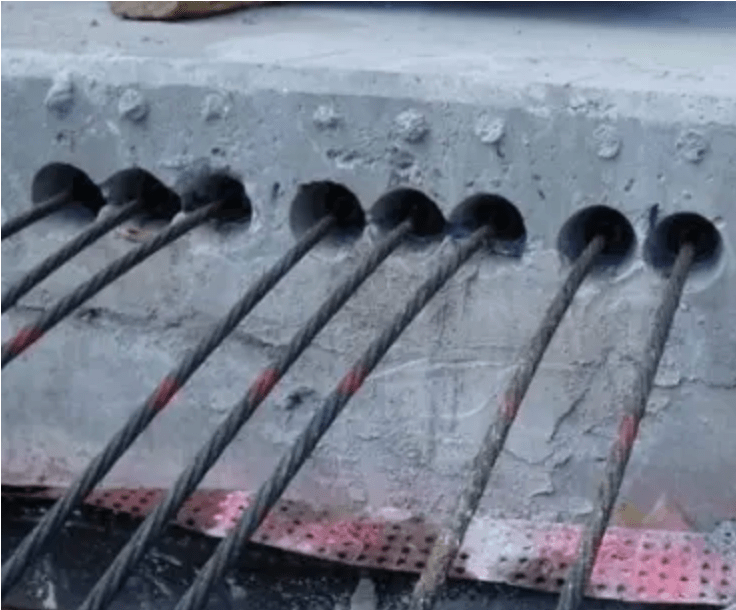
Why Engineers Use Them
So why bother with these steel “guitar strings” inside a building?
- Longer spans: Great for parking garages, bridges, and condos without forest-like columns.
- Thinner slabs: Saves material and cost.
- Crack control: Reduces shrinkage cracks in concrete.
- Stronger structures: Helps resist heavy live loads like vehicles or crowds.
In South Florida, where developers love wide-open parking garages and open floorplans, post-tension is practically everywhere particularly in newer buildings.
Why Post-Tension Cables Can Be Dangerous
Here’s the catch: a post-tension cable is a loaded spring hiding in your ceiling.
The Risks
- Sudden Failure: If a strand snaps, it releases stored energy violently. That’s the loud “bang” residents sometimes hear.
- Concrete Damage: The cable can punch through slabs, spall concrete, or drop debris.
- Corrosion: Florida’s salty air and high humidity corrode steel fast. Rust at the stressing pocket can eventually cause strand failure (ACI 423.7R-05).
- Accidental Cuts: Contractors drilling into slabs without scanning first can cut a cable. The result? Expensive repairs, dangerous recoil, and liability headaches.
Who Should Be Careful
- Homeowners/Residents: Report rust stains, cracks near stressing pockets, or unexplained bangs.
- Property Managers: Schedule regular inspections and preventative maintenance.
- Engineers/Contractors: Always scan for post-tension cables before coring or drilling.
- Everyone: Never assume “that little rust spot” is harmless.
True Story to Learn From
One night in a coastal South Florida city, a condo resident woke up to a loud bang in his living room. Startled, he ran out to find chunks of concrete on the floor. Even worse, a steel cable was sticking out of his ceiling.
When I arrived, I knew exactly what I was looking at: a broken post-tension strand.
At first, we suspected someone might have been drilling through the slab above. But after inspection, we realized the truth. The end of the cable at the stressing pocket had corroded, weakened by years of salt exposure. Rust stains had been visible on the outside of the building, but nobody acted on them. Eventually, the steel gave way, and the strand snapped under pressure.
The condo board brought me in to investigate further. What we found was sobering: not just one bad cable, but around 50 others with corrosion issues. We were hired to analyze, design, repair and replace them.
Thankfully, this story had a happy ending. The building was stabilized, residents were safe, and management finally understood the importance of proactive maintenance. But the situation could have been much worse — imagine if that failure had happened in a crowded living room or during a holiday gathering.
How to Spot and Prevent Problems
Signs of Trouble:
- Rust stains near slab edges or stressing pockets.
- Loud bangs followed by concrete cracks.
- Unexplained ceiling cracks or spalling.
- Exposed steel visible on the slab exterior.
Precautions:
- Schedule regular inspections by licensed engineers.
- Use ground-penetrating radar (GPR) before drilling into any slab.
- Seal stressing pockets and protect exposed ends from saltwater intrusion.
- Educate residents to report strange noises or cracks immediately.
Different Perspectives
Some contractors argue that post-tension cables are “perfectly safe” if installed correctly and maintained. And in many cases, they are. But in Florida’s coastal environment, the real enemy is time + salt air.
Others claim that simple patching of cracks near stressing pockets is sufficient. Unfortunately, research shows that once corrosion begins, it can progress rapidly inside the anchorage (Federal Highway Administration, FHWA, 2018). Ignoring it just delays the inevitable. The truth lies in the middle: post-tension cables are powerful tools when respected, inspected, and protected. But neglect them, and they become hazards hiding in plain sight.
| Component | Description | Visual Analogy |
| Strand | High-strength steel cable that is tensioned to reinforce the slab | Like the string of a guitar pulled tight |
| Duct | Sleeve or pathway in which the strand sits inside the concrete | Like a straw guiding the string through the concrete |
| Anchorage / Stressing Pocket | The end location where the strand is stressed (tightened) and secured | Like the tuning peg of the guitar holding the string |
| Concrete Slab | The hardened concrete that holds the post-tension system in place | Like the guitar body keeping everything together |