
Summary
Florida roads take a beating—not just from hurricanes, sun, and humidity, but from something much heavier: overweight trucks. In this blog, I’ll explain the science behind how too much weight destroys roads far faster than most people think, why laws are in place to control truck loads, and what engineers do to design pavements that can survive the punishment. I’ll also share a real-world story about a failed “perpetual pavement” in Michigan and what Florida drivers and property owners can learn from it.
From the Appian Way to I-95: A Brief Road History Lesson
When Roman engineers built the Appian Way around 312 B.C., they weren’t worried about semi-trucks hauling avocados from Miami to Publix. The biggest traffic hazard back then was a grumpy donkey cart. The Appian Way was made of carefully laid stone blocks and has lasted over 2,000 years (and you thought your HOA’s driveway warranty was impressive).
Fast forward to modern times: roads are now designed to carry millions of cars and trucks, day after day. But here’s the kicker—roads don’t age gracefully when overloaded. A road designed for normal traffic may hold up fine under cars, but a single overweight truck can do the damage of thousands of cars in one go.
This is why road engineers like me lose sleep over load calculations. Unlike Roman roads, ours are expected to deal with eighteen-wheelers, dump trucks, and construction haulers barreling down I-95 at 70 mph.
How Engineers Design Roads (and Why Weight Is a Big Deal)
Designing a road isn’t as simple as pouring asphalt and hoping for the best. There’s a whole science called pavement engineering, and trust me, it involves more math than you ever wanted in your life. Engineers look at things such as:
- Type of use: Residential street vs. highway vs. port access road.
- Expected traffic: How many cars, buses, and trucks will use it daily.
- Maximum loads: The heaviest vehicles legally allowed.
- Axle counts: More axles = weight spread out, less damage.
- Curves and radiuses: Tighter curves = more stress on pavement edges.
- Drainage: Water weakens pavement layers faster than anything.
- Material choices: Asphalt, concrete, or hybrids.
- Functional life: How many years the road should last before major rehab.
Now, here’s the sciencey part made simple: pavement damage doesn’t increase linearly with weight. Instead, it’s exponential. According to the American Association of State Highway and Transportation Officials (AASHTO), a truck axle that is twice as heavy can cause up to 16 times more damage than a properly loaded one (Source: AASHTO Pavement Design Guide).
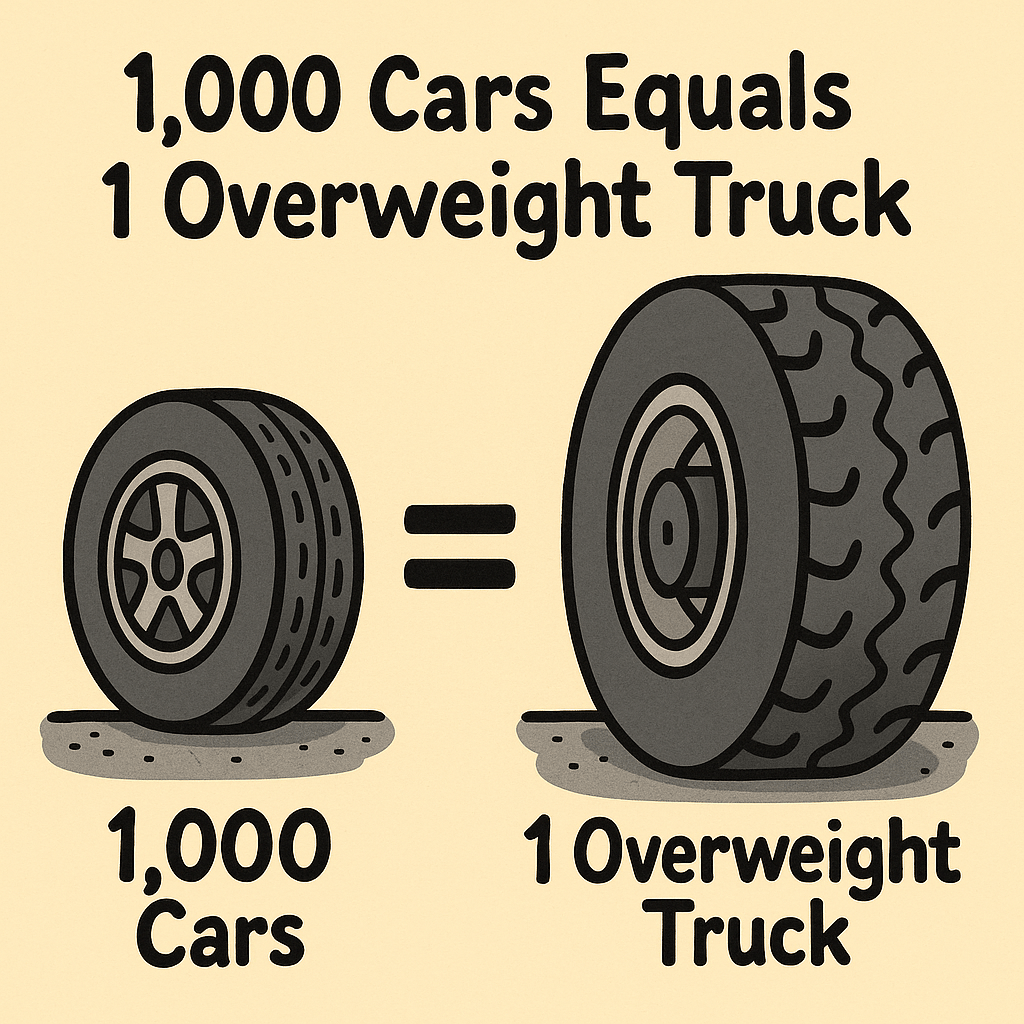
That means one overweight truck can wreak the same havoc as thousands of cars. Think of it like this: if cars are mosquitos, trucks are bowling balls. Squash a few mosquitos—no problem. Drop a bowling ball? Goodbye coffee table.
Why Axles Matter More Than You Think
Weight isn’t just about the number on the scale—it’s how that weight is distributed. A fully loaded semi with 18 wheels spreads its load better than a heavy dump truck with only a few axles. That’s why engineers obsess over “load per axle.”
For example:
- A 40,000-lb truck with 10 axles spreads the load = road survives.
- A 40,000-lb truck with 2 axles concentrates the load = road cries uncle.
Florida law reflects this. Truck weight limits aren’t just about total pounds—they also factor in axle spacing and distribution (Source: Florida Department of Transportation, FDOT Truck Weight Regulations).
Why Overweight Trucks Are Such a Problem in Florida
Florida has unique challenges:
- Tourism & shipping hubs: Ports in Miami, Fort Lauderdale, and Tampa mean lots of heavy cargo.
- Agriculture: Sugarcane, citrus, and vegetables = endless convoys of produce trucks.
- Construction boom: Dump trucks and concrete mixers are everywhere.
- Soils & climate: Sandy soil and heavy rains make pavements weaker.
When overweight trucks sneak past weigh stations or are allowed on roads not designed for them, the result is potholes, rutting, cracking, and—worst of all—roads that fail years ahead of schedule. And who pays for that? All of us, through taxes and endless construction delays.
True Story to Learn From: The Michigan “Perpetual Pavement” Failure
Now let me share a story that road engineers still talk about—part horror movie, part cautionary tale.
In Michigan, a section of highway was designed as a “perpetual pavement.” That’s a fancy way of saying it was supposed to last nearly forever with just surface touch-ups. The idea was beautiful: build it once, maintain it lightly, and the road will outlive your mortgage.
But then reality happened. Overweight trucks pounded that highway day and night. Instead of lasting decades, the pavement started failing within just a few years. Engineers dug in (literally) and found deep structural damage. The loads had exceeded what the design accounted for, and the pavement was never given a fighting chance.
Lesson learned: no matter how advanced your materials or design, if overweight trucks keep rolling unchecked, they’ll break your road. Period.
And that’s exactly why Florida enforces strict truck weight laws and maintains weigh stations across the state.
Different Perspectives
Some folks argue:
- “It’s just one truck—how much damage can it do?”
- “Roads should be designed tougher so we don’t have to worry about loads.”
- “Weight laws slow down commerce and cost businesses money.”
Here’s the truth:
- One truck can equal the damage of 1,000 cars (not my opinion, that’s AASHTO math).
- Roads already cost millions per mile. Designing every road to carry extreme overweight loads would bankrupt taxpayers.
- Commerce still moves just fine when trucks follow existing weight limits. In fact, it moves better, because we don’t have constant lane closures from failing pavement.
So yes, the laws are annoying if you’re the trucker getting flagged. But for the rest of us, those laws keep our roads drivable and our tires out of the potholes.