
Summary
If you live in a condo or manage one, chances are you’ve heard the dreaded words: “You need concrete repair.” But how do you really know if those repairs are truly necessary—or if someone’s just trying to squeeze money out of your building fund? In this blog, I’ll explain what spalling is, why concrete issues get worse at a geometric rate, and why the law in Florida leaves little wiggle room once an engineer says repairs are required. I’ll also share a story about the most infamous collapse in Florida’s history, and why that tragedy forever changed how engineers, Boards, and property managers deal with concrete problems.
What Is Spalling—and Why Should You Care?
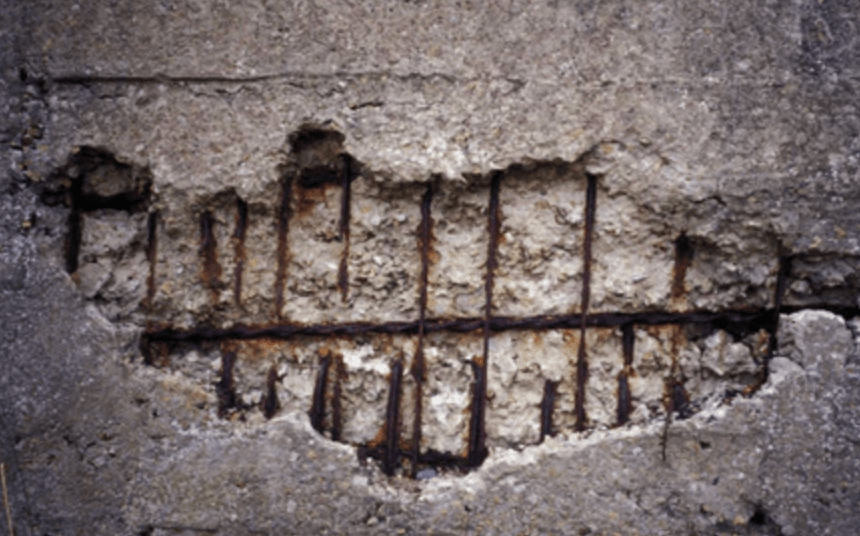
If you want a simple definition, spalling is when pieces of concrete start flaking, cracking, or breaking away, usually because water (Chlorides) has gotten to the steel reinforcement inside and caused it to rust. The steel expands as it rusts, pushing the surrounding concrete outward like popcorn in a microwave.
Now here’s the kicker: spalling doesn’t grow slowly. It grows at a geometric rate. That means the problem doesn’t just double—it can multiply exponentially, like a credit card balance that you never pay off. One little crack today becomes a whole panel tomorrow, and then suddenly your parking garage looks like it’s auditioning for a demolition scene in a movie.
When left unattended, spalling:
- Weakens structural integrity.
- Increases repair costs dramatically.
- Spreads into adjacent areas.
- Jeopardizes life safety.
(And no, putting duct tape on it will not help, despite what your uncle with a toolbox and a six-pack might tell you.)
Why You Can’t Just Ignore Concrete Repairs
Here’s the part nobody likes to hear: if an engineer finds a structural problem, you can’t wish it away. Florida law is very clear about this.
40-Year Recertification (Now “Milestone Inspections”)
In Miami-Dade and Broward Counties, once your building hits 40 years (and every 10 years thereafter), it must go through a structural and electrical recertification. These inspections have been renamed and updated after the Champlain Towers tragedy, but the concept is the same: if repairs are required, they must be done.
If you fail the inspection, your building won’t pass. Kick the can too far down the road, and the Building Department can—and has—issued orders to vacate or demolish buildings.
Structural Integrity Reserve Studies (SIRS)
Florida’s new laws also require condo associations to conduct a Structural Integrity Reserve Study. This study forecasts how much money the association needs to save for future repairs. If the report says you’ll need $5 million in repairs in six years, guess what? You legally have to set aside those funds and then spend them on those repairs when the time comes.
So when residents or Board members ask, “Do we really need to do this?” the answer is: if it’s in the SIRS, you do. The law doesn’t allow you to reallocate those funds to a new pool deck or lobby chandelier.
Engineers’ Duty to Report
Another key point: engineers in Florida have a legal responsibility to report dangerous conditions directly to the Building Official. Even if a Board would prefer to “keep things quiet,” if I see something that affects the safety of residents, I am required to report it. If I don’t, I could lose my license.
That’s why I often tell residents and Boards:
- If an engineer says it needs repair, that’s almost always the final word.
- Second opinions rarely change things.
- Save your money for the repair itself instead of paying multiple engineers to tell you the same bad news.
(Source: Florida Statutes Chapter 553, Building Construction Standards)
| Sign or Symptom | What It Might Mean | Why It Matters | Typical Action Required |
| Cracks in concrete surfaces | Possible spalling or structural stress | Cracks allow water to penetrate and reach reinforcing steel, accelerating corrosion | Inspection by engineer; repair may involve sealing or structural patching |
| Rust stains on walls or ceilings | Corroding rebar inside concrete | Indicates rebar expansion is pushing against concrete, leading to spalling | Engineer evaluation; chipped-out concrete and rebar treatment/replacement |
| Chipping or flaking concrete | Concrete spalling in progress | Loss of concrete cover weakens structural integrity | Concrete repair with proper patch materials |
| Exposed rebar | Severe deterioration | Rebar corrodes quickly when exposed, reducing structural strength | Immediate repair required; rebar cleaning, coating, and patching |
| Water leaks through slabs or walls | Compromised waterproofing or cracks | Water intrusion accelerates damage and may impact habitability | Leak detection, waterproofing, and repair |
| Uneven or sagging slabs | Potential foundation or structural failure | May indicate widespread deterioration or load issues | Full structural evaluation and possible major repair |
| Visible mold or damp spots | Moisture intrusion | Moisture worsens concrete deterioration and affects air quality | Identify source of water and repair affected concrete areas |
The Psychology of Concrete Repairs
Let’s be honest: nobody likes being told they need to spend potentially millions of dollars on repairs they can’t see or touch. It’s like being told you need surgery on an organ you didn’t know you had.
Here are some of the reactions I encounter when I deliver a concrete repair diagnosis:
- Denial: “It’s just a crack; can’t we just patch it with paint?”
- Suspicion: “Are you sure you’re not just trying to get a big contract out of us?”
- Deflection: “Let’s wait until the next Board is elected to deal with this.”
- Acceptance: Rare, but it does happen.
The truth is, concrete repair is like going to the dentist. Ignore the cavity today, and you’ll be paying for a root canal tomorrow.
True Story to Learn From
Back in 2017, I was called out to inspect a beachfront high-rise in South Florida. I walked through their garage and immediately saw signs of spalling and rusted reinforcement. I told the Board that repairs were needed and urged them to address the problem as soon as possible.
The residents didn’t like what they heard. I got the usual mix of skepticism, eye rolls, and the silent treatment in the elevator ride down. Nobody wants to be the bearer of bad news, but that’s part of my job.
Fast forward four years. That very same building collapsed. It was Champlain Towers in Surfside. Ninety-eight lives were lost. Families shattered. And Florida changed forever.
Now, to be clear, I’m not saying my inspection alone could have prevented the collapse. The story is much longer and more complex, with many contributing factors. But the lesson is this: when engineers raise red flags about structural problems, ignoring them can lead to catastrophic consequences.
That’s why Florida’s laws have tightened since Surfside. No more “kicking the can down the road.” No more patch jobs to get through another year. Safety has to come first, even if it’s expensive.
(Source: National Institute of Standards and Technology report on Champlain Towers, 2023)
How to Know If You Really Need Concrete Repair
So let’s come back to the original question: “How do I know if my building really needs concrete repair?”
Here’s the checklist:
- An engineer has identified spalling or structural cracks.
→ That’s the biggest red flag. If it’s in a written report, it’s not optional. - Your 40-year or milestone inspection requires it.
→ You cannot pass inspection without completing the repairs. - Your Structural Integrity Reserve Study has forecasted it.
→ You’re legally required to fund and perform those repairs. - There are visible signs of distress.
→ Cracks, rust stains, water intrusion, or falling pieces of concrete are all signals. - An engineer has reported conditions to the Building Official.
→ At that point, the city or county is officially aware. Noncompliance can result in vacate or demolition orders.
Short answer: if an engineer says it needs repair, you pretty much have to get it done.
Different Perspectives
The Skeptics
Some Board members or residents think engineers are too conservative and “call repairs” that aren’t necessary. They argue that engineers are just trying to drum up business for contractors.
Here’s the problem with that logic: engineers don’t have much to gain based on how much repair work is performed. Our role is to observe, diagnose, and report conditions. If we ignore issues, we risk losing our license—or worse, being held liable if the structure fails.
Florida law (and building codes like the Florida Building Code and ACI 562-19) are designed with safety margins built in. That means by the time an engineer calls out a repair, the condition is already beyond the point of “wait and see.”
(Source: American Concrete Institute ACI 562-19, Code Requirements for Assessment, Repair, and Rehabilitation of Existing Concrete Structures)
Bibliography
Source: American Concrete Institute (ACI 562-19). Code Requirements for Assessment, Repair, and Rehabilitation of Existing Concrete Structures.
Source: Florida Statutes Chapter 553. Building Construction Standards.
Source: National Institute of Standards and Technology (NIST). Investigation into the Partial Collapse of Champlain Towers South.
For additional information you can access the following:
- Miami-Dade County Building Department — miamidade.gov
- Florida Board of Professional Engineers — fbpe.org