
Summary
Concrete repair projects in Florida have a notorious reputation for going over budget. In this blog, I’ll break down the top three reasons why it happens—hidden conditions, underestimated quantities, and change orders—plus a few honorable mentions like material price escalation and contractor performance. I’ll also share a real-life story from a South Florida condo project where the budget ballooned sixfold, and what property managers and Boards can learn from it.
Reason 1- The Hidden Conditions Nobody Wants to Talk About
If you’ve ever had a toothache, you know that what you see in the mirror (a tiny dark spot) is only the beginning. By the time the dentist pokes around, suddenly you’re scheduling a root canal and rethinking your sugar habits. Concrete repair works the same way.
When engineers like me go out to quantify spalling or deterioration, we’re often limited by what we can see. We walk the building, tap surfaces with hammers, check balconies, parking garages, and columns, and make the best estimate we can. But concrete is sneaky. A small crack on the outside may hide a spider web of corrosion inside. Once contractors start chipping away, we often discover that the damage goes much deeper and wider than what was visible during inspection (Source: American Concrete Institute ACI 562-19).
This isn’t because engineers are bad at their jobs—it’s because we don’t carry x-ray vision goggles. Even advanced tools like ground-penetrating radar or half-cell corrosion testing give us only probabilities, not certainties. The truth is, hidden conditions are the single biggest budget-buster in concrete restoration.
What can boards and homeowners do?
One practical step is to budget a contingency fund—typically 15–25% of the projected repair costs—for hidden conditions. Think of it as the rainy-day fund for your building. If the hidden problems don’t show up, you can always reallocate the money. But if they do—and they usually do—you’re not blindsided.
Reason 2- Underestimated Quantities
This reason is often confused with hidden conditions, but they’re not quite the same. Hidden conditions are surprises we literally couldn’t see until demolition began. Underestimated quantities, on the other hand, are sometimes the result of optimistic projections, rushed inspections, or even just the natural difficulty of predicting how many cubic feet of concrete will ultimately need replacing.
For example, during a safety inspection, I may estimate that 10% of the garage deck is compromised. Once the contractor mobilizes and starts chipping, it turns out to be 25%. The quantity itself wasn’t “hidden”—it was underestimated.
What can be done about it?
Boards and managers can reduce the risk of underestimated quantities by insisting on thorough inspections before bidding. That might include destructive testing—yes, actually breaking into a few sample spots to see what’s really going on beneath the surface. It costs money upfront, but it’s cheaper than writing six-figure change orders later. Getting multiple bids and comparing not just the price but the scope of assumed repairs also helps spot underestimates.
Reason 3- Change Orders
Ah, the dreaded change order. If hidden conditions are the toothache and underestimated quantities are the cavity, change orders are the dental crown you didn’t budget for but suddenly need.
In concrete repair, change orders can arise from two main sources:
- Necessary changes because the damage is worse than expected.
- Elected changes because the board or owners decide to upgrade.
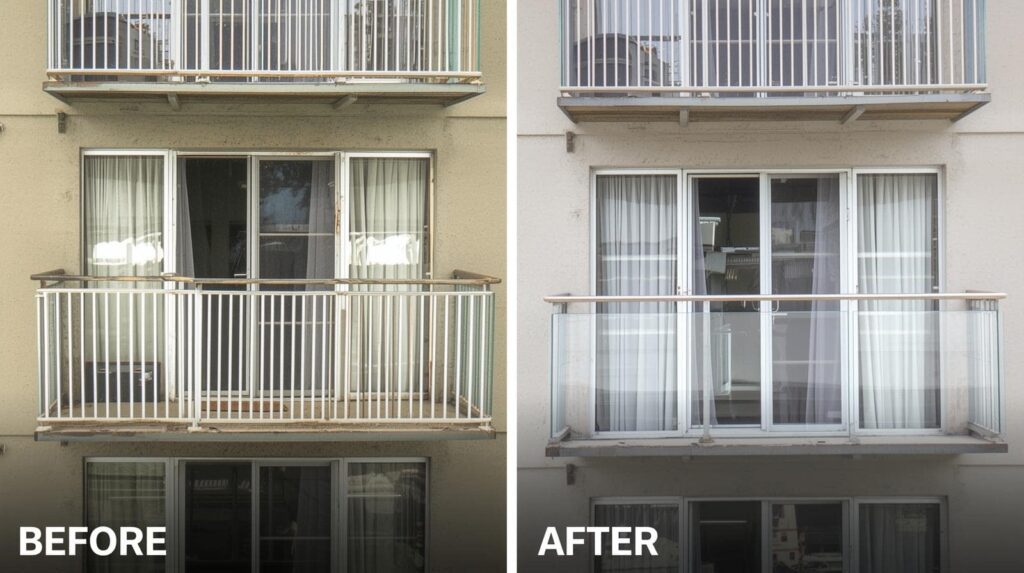
I’ve seen both. Sometimes, a change order is unavoidable, like when new cracks appear mid-project. Other times, a newly elected board wants to replace all the windows, sliding glass doors, or railings while the contractor is already on-site. These “scope creep” decisions can turn a $2.5 million project into a $15 million project (more on that in the story below).
How to minimize change orders?
The key is clear planning and scope definition from the beginning. If you think new windows might be in your building’s future, bake them into the original project. Make sure your contracts have a clear change order process with oversight from your engineer. And keep open communication between the engineer, contractor, and Board so surprises don’t derail the budget.
Honorable Mentions
While hidden conditions, underestimated quantities, and change orders are the big three, two other issues deserve recognition:
Material Price Escalation.
Concrete, reinforcing steel, epoxy, and coatings are global commodities. Prices rise with inflation, tariffs, or supply chain disruptions. Anyone who lived through 2020–2022 saw material costs shoot up mid-project. That’s why locking in pricing with your contractor when possible is so important (Source: Associated General Contractors of America).
Contractor Performance Issues.
Concrete repair is a specialized trade. Unfortunately, not every contractor is equally skilled, and Florida has a shortage of experienced restoration crews. If work has to be redone, or if corners are cut, costs rise fast. Choosing contractors with a proven track record in structural repair is critical. And remember, repairing bad concrete repairs costs significantly more than doing it right the first time.
True Story to Learn From
A few years back, I worked as the engineer and owner’s representative on a large seaside condo in Dade County. The initial budget was about $2.5 million. Reasonable enough, right? Well, by the time the project wrapped up, the final tab was closer to $15 million.
Surprised? I figure you’d be. But here’s what happened: a new incoming board decided they wanted brand new sliding glass doors, windows, and glass railings on the entire property. That decision alone added millions. On top of that, the concrete repair quantities were underestimated and the change orders piled up.
Here’s the silver lining: by the time the project finished, the building looked stunning. Its market value shot up, and residents were proud of their investment. The downside? HOA fees rose significantly, and some residents couldn’t afford to stay. It was a happy ending for the building, but not for everyone inside it.
Different Perspectives
Some in the industry argue that hidden conditions and underestimated quantities shouldn’t be excuses—that engineers should be able to predict everything upfront. But the reality is more complex. Even with destructive testing, corrosion can spread unpredictably, especially in coastal Florida where saltwater intrusion accelerates deterioration. Other critics claim that change orders are often “padding” by contractors. While there’s no denying that unethical practices exist, in most cases, change orders reflect legitimate shifts in scope or conditions. This is why having a trusted engineer oversee the process is so vital.
Bibliography
Source: American Concrete Institute (ACI 562-19). Code Requirements for Assessment, Repair, and Rehabilitation of Existing Concrete Structures.
Source: Associated General Contractors of America. Construction Inflation Alert. www.agc.org
Source: Florida Statutes, Chapter 718 & 720. Condominium and HOA laws regarding structural integrity reserves. www.leg.state.fl.us
Source: Florida Building Code, 2023 Edition.
Source: International Concrete Repair Institute (ICRI). Guidelines for Concrete Repair.
For additional information you can access the following:
- Concrete International (www.concrete.org)
- Florida Engineering Society (www.fleng.org)